Showing posts with label book review. Show all posts

Wednesday, July 25, 2018

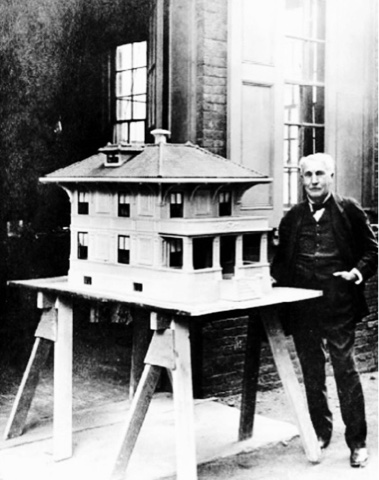
Thomas A. Edison: Poured Concrete House Pioneer

Thomas A. Edison


Thomas A. Edison


Thomas A. Edison


Thomas A. Edison


At 303 North Mountain Avenue in Montclair, New Jersey, there stands a very solid relic to Thomas Edison’s past --  a poured concrete house that was a prototype for what Edison hoped to be the future of urban and suburban development.  

One of only a handful of Edison’s original concrete houses in existence today, 303 North Mountain stands gloriously modern in its concrete design, but is in fact one of Montclair’s antique homes. Thomas Brennan, an actor and director, boasts it as his own and describes it like a piece of art, rather than a structure.


Thomas A. Edison


Speaking of reading the backlog, I’m now reading a compelling bio of Thomas A. Edison, a 2017 Christmas gift.

This is a nifty format indeed — filled with great graphics — it's somewhere between the classic “young adult” reader’s biography of yore and a graphic novel of today. It’s a whole lot of fun to read. Bonus — it has old comic book pages reproduced and vintage editorial cartoons by R. F. Outcault.

By David J Kenton 

This book is designed to appeal to a wide range of readers who want to learn things about Edison not told in other biographies. Packed with colorful and rare illustrations, “Edison: The Inventor of the Modern World” is visually stunning and the writing is light and easy.

Beginning with his upbringing in Milan, Ohio, and Port Huron, Michigan, the book explores how the insatiable curiosity of "Little Al" made his father wonder if he was a bit dimwitted and led his first teacher to call him "addled." Self-teaching through experiment and reading, young Edison quickly shows his inventiveness and business acumen, leaving his doubters well behind at an early age.

Chapters examine his teen years while the Civil War raged, his early improvements to telegraphs, and his contributions to the art of invention. Edison, now called "Tom," rises to celebrity status with the telephone and telegraph, explores the world in his efforts to build a better light bulb, and fights the intriguing War of the Currents against rivals Westinghouse and Tesla. Along the way he acquires two wives, six children, and friendships with some of the greatest names in business history.

Not slowing down as he aged, Edison becomes a movie mogul, an iron ore magnate, builds houses out of concrete, becomes a botanical rubber expert, writes notes for a science fiction novel, and accomplishes much, much more before passing away in his sleep at the ripe old age of 84.

“Edison: The Inventor of the Modern World” tells the story of a man who has left a legacy that few can hope to equal. He was a great deal more than people know, perhaps in both good and bad ways. All are laid out in easy to read language and with spectacular photos, cartoons, and drawings in a format that blends the best of vivid writing with a graphical novel feel.

I am the author of this book. I hope you enjoy reading it as much as I enjoyed writing it. See also my earlier book, “Tesla: The Wizard of Electricity.”


Thomas A. Edison


Thomas A. Edison


Thomas A. Edison


Thomas A. Edison


Thomas A. Edison


Tuesday, July 24, 2018

A. R. Luria: "The Mind of a Mnemonist"

A. R. Luria


I'm now catching up on my garage sale book-buy reading of last summer -- namely, the classic study of a memory "super-savant." The descriptions of the way "S." combines his synesthesia sensations to build a "memory palace" for his images is fascinating. (A. R. Luria studied Solomon Shereshevskii, a Russian journalist with a seemingly unlimited memory, sometimes referred to in contemporary literature as "flashbulb" memory, in part due to his five-fold synesthesia.)

"A welcome re-issue of an English translation of Alexander Luria's famous case-history of hypermnestic man. The study remains the classic paradigm of what Luria called 'romantic science, ' a genre characterized by individual portraiture based on an assessment of operative psychological processes. The opening section analyses in some detail the subject's extraordinary capacity for recall and demonstrates the association between the persistence of iconic memory and a highly developed synaesthesia. The remainder of the book deals with the subject's construction of the world, his mental strengths and weaknesses, his control of behavior and his personality. The result is a contribution to literature as well as to science.

Luria's essay is a model of lucid presentation and is an altogether convincing description of a man whose whole personality and fate was conditioned by an intellectual idiosyncrasy.

A distinguished Soviet psychologist's study...[of a] young man who was discovered to have a literally limitless memory and eventually became a professional mnemonist. Experiments and interviews over the years showed that his memory was based on synesthesia (turning sounds into vivid visual imagery), that he could forget anything only by an act of will, that he solved problems in a peculiar crablike fashion that worked, and that he was handicapped intellectually because he could not make discriminations, and because every abstraction and idea immediately dissolved into an image for him. It is all fascinating and delightful."

Wednesday, June 13, 2018

Mini Book Review: Michael Pollan's "How to Change Your Mind"

Michael Pollan


I want to read this, but I don't want to spend much money. Since I don't read ebooks, a trip to the Loussac Library may be in order...

"The value of psychedelics is not the experience of them -- the grooviness of the moment -- but the sediment the experience leaves behind.

It’s possible these effects can be chalked up, in part, to the drug’s effect on the brain’s so-called 'default mode network,' especially the part associated with 'self-referential thought.' Pollan grants, if briefly, that turning off the network --truly 'getting over yourself' -- might also be achieved through 'certain breathing exercises,' or through 'sensory deprivation, fasting, prayer, overwhelming experiences of awe, extreme sports, near-death experiences, and so on.'

Pollan doesn’t give a lot of prime real estate to psychedelics’ naysayers. But given that those on LSD can appear to be losing their minds, and that the drug leaves one feeling emotionally undefended (a potential benefit as well as a profound risk), he does strongly recommend having an experienced guide in a proper setting when you trip. With those safeguards in place, he believes usage could be on the verge of more widespread acceptance, pointing out that plenty of other once widely-derided practices redolent of the 1960s, like yoga and natural birth, are now common."

Among other things, Pollan discusses the ways that psychedelics 'dissolve our sense of self,' and the potential mental health benefits they bestow as a result. “Psilocybin gives you such a powerful psychological experience that it kind of reboots your brain, your mind,” he says. “A lot of depression is a sort of 'self-punishment,' as even Freud understood. We get trapped in these 'loops of rumination' that are very destructive, and the stories that we tell ourselves: you know, 'that we’re unworthy of love, that we can’t get through the next hour with a cigarette,' whatever it is. And these deep, deep 'grooves of thought' are very hard to get out of. They disconnect us from other people, from nature, from an earlier idea of who we are. The 'mystical experience,' as it’s sometimes called, or the 'experience of the dissolution of the ego,' gets us 'out of those grooves' and gives us a break from 'the tyranny of the ego,' which can be a very 'harsh ruler.'”

Friday, May 25, 2018

Michael Pollan: How to Change Your Mind

Michael Pollan


Michael Pollan has a new book out:

A brilliant and brave investigation by Michael Pollan, author of five New York Times best sellers, into the medical and scientific revolution taking place around psychedelic drugs--and the spellbinding story of his own life-changing psychedelic experiences 

When Michael Pollan set out to research how LSD and psilocybin (the active ingredient in magic mushrooms) are being used to provide relief to people suffering from difficult-to-treat conditions such as depression, addiction and anxiety, he did not intend to write what is undoubtedly his most personal book. 

But upon discovering how these remarkable substances are improving the lives not only of the mentally ill but also of healthy people coming to grips with the challenges of everyday life, he decided to explore the landscape of the mind in the first person as well as the third. Thus began a singular adventure into various altered states of consciousness, along with a dive deep into both the latest brain science and the thriving underground community of psychedelic therapists. 

Pollan sifts the historical record to separate the truth about these mysterious drugs from the myths that have surrounded them since the 1960s, when a handful of psychedelic evangelists inadvertently catalyzed a powerful backlash against what was then a promising field of research.

A unique and elegant blend of science, memoir, travel writing, history, and medicine, How to Change Your Mind is a triumph of participatory journalism. By turns dazzling and edifying, it is the gripping account of a journey to an exciting and unexpected new frontier in our understanding of the mind, the self, and our place in the world. The true subject of Pollan's "mental travelogue" is not just psychedelic drugs but also the eternal puzzle of human consciousness and how, in a world that offers us both suffering and joy, we can do our best to be fully present and find meaning in our lives.

Number of Pages: 465

Tuesday, August 29, 2017

On the Reading Table: NeuroTribes by Steve Silberman

Steve Silberman


NeuroTribes:

The Legacy of Autism and the Future of Neurodiversity

A groundbreaking book that upends conventional thinking about autism and suggests a broader model for acceptance, understanding, and full participation in society for people who think differently.
What is autism? A lifelong disability or a naturally occurring form of cognitive difference akin to certain forms of genius? In truth, it is all of these things and more -- and the future of our society depends on our understanding it. Wired reporter Steve Silberman unearths the secret history of autism, long suppressed by the same clinicians who became famous for discovering it, and finds surprising answers to the crucial question of why the number of diagnoses has soared in recent years.
Going back to the earliest days of autism research and chronicling the brave and lonely journey of autistic people and their families through the decades, Silberman provides long-sought solutions to the autism puzzle, while mapping out a path for our society toward a more humane world in which people with learning differences and those who love them have access to the resources they need to live happier, healthier, more secure, and more meaningful lives.
Along the way, he reveals the untold story of Hans Asperger, the father of Asperger’s syndrome, whose “little professors” were targeted by the darkest social-engineering experiment in human history; exposes the covert campaign by child psychiatrist Leo Kanner to suppress knowledge of the autism spectrum for fifty years; and casts light on the growing movement of “neurodiversity” activists seeking respect, support, technological innovation, accommodations in the workplace and in education, and the right to self-determination for those with cognitive differences.
NeuroTribes was the first science book to win the Samuel Johnson Prize. It has also won a California Book Award and a Books for a Better Life Award.

Mini Reviews

Explores in fascinating, near-encyclopedic depth how autism has evolved… a gripping narrative written with journalistic verve.
The Guardian
An essential resource. My own copy is already dog-eared.”
Nature
NeuroTribes is a sweeping and penetrating history, presented with a rare sympathy and sensitivity. It is fascinating reading; it will change how you think of autism, and it belongs, alongside the works of Temple Grandin and Clara Claiborne Park, on the bookshelf of anyone interested in autism and the workings of the human brain.
— From the foreword by Oliver Sacks, author of An Anthropologist On Mars and Awakenings
The monks who inscribed beautiful manuscripts during the Middle Ages, Cavendish an 18th century scientist who explained electricity, and many of the geeks in Silicon Valley are all on the autism spectrum. Silberman reviews the history of autism treatments from horrible blaming of parents to the modern positive neurodiversity movement. Essential reading for anyone interested in psychology.”
Temple Grandin, author of Thinking in Pictures and The Autistic Brain
NeuroTribes is remarkable. Silberman has done something unique: he’s taken the dense and detailed history of autism and turned the story into a genuine page-turner. The book is sure to stir considerable discussion.
John Elder Robison, Neurodiversity Scholar in Residence at The College of William & Mary and author of Look Me in the Eye
Be prepared to overturn all prior knowledge you had about autism. With meticulous research, Steve Silberman has unearthed the surprising truths about the history of autism, uncovering the roots of the lie of the autism “epidemic.” Be prepared to share the deeply compassionate understanding that the author bestows on the many different individuals we now include in the autism spectrum. His empathy touches even the villains of the story, and this is both moving and apt when he advises us all to embrace diversity. This gripping and heroic tale is a brilliant addition to the history of autism.
Uta Frith, Emeritus Professor of Cognitive Development at University College London
In this genuine page-turner, Steve Silberman reveals the untold history of autism: from persecution to parent-blaming, from Rain Man to vaccines, of doctors for whom professional ego trumped compassion, to forgotten heroes like Hans Asperger, unfairly tainted by Nazi links. It ends on an optimistic note, with ‘autistics’ reclaiming the narrative and defining autism in their terms — more difference than disability and an essential part of the human condition. Highly recommended for anyone with an interest in autism or Asperger’s, or simply a fascination with what makes us tick.
Benison O’Reilly, co-author of The Australian Autism Handbook

Monday, June 19, 2017

Frances Glessner Lee: Deadly Dioramas

Frances Glessner Lee


Frances Glessner Lee


Frances Glessner Lee


Frances Glessner Lee


Frances Glessner Lee

I ordered a copy of this fascinating book to see what's what...

The Nutshell Studies of Unexplained Death offers readers an extraordinary glimpse into the mind of a master criminal investigator

Frances Glessner Lee, a wealthy grandmother, founded the Department of Legal Medicine at Harvard in 1936 and was later appointed captain in the New Hampshire police. In the 1940s and 1950s she built dollhouse crime scenes based on real cases in order to train detectives to assess visual evidence

Still used in forensic training today, the eighteen Nutshell dioramas, on a scale of 1:12, display an astounding level of detail: pencils write, window shades move, whistles blow, and clues to the crimes are revealed to those who study the scenes carefully. 

Corinne May Botz's lush color photographs lure viewers into every crevice of Frances Lee's models and breathe life into these deadly miniatures, which present the dark side of domestic life, unveiling tales of prostitution, alcoholism, and adultery. 

The accompanying line drawings, specially prepared for this volume, highlight the noteworthy forensic evidence in each case. Botz's introductory essay, which draws on archival research and interviews with Lee's family and police colleagues, presents a captivating portrait of Lee.


Monday, May 22, 2017

The Pleasures of "Slow Food"

Slow Food


"In a world increasingly dominated by fast food, The Pleasures of Slow Food celebrates heritage recipes, artisan traditions, and the rapid evolution of a movement to make good food a part of everyday life. 

"Slow Food" is defined by how it's made -- if it's allowed to ripen before it's harvested, prepared by hand and enjoyed among friends it's "Slow Food." It's a philosophy, a way to farm, a way to cook -- a way to live. It's also the name of a 65,000-strong international movement, numbering among its members some of the most distinguished names in the food world. 

The Pleasures of Slow Food showcases over 60 recipes from the world's most innovative chefs for dishes that feature local handmade ingredients and traditional cooking methods. Premier food writer Corby Kummer also profiles Slow Food's luminaries, such as Italian cheese-maker Roberto Rubino and Canadian Karl Kaiser, who makes sweet ice-wine. 

Pairing fantastic recipes with engaging stories, The Pleasures of Slow Food brings the best of the food world to the kitchen table."  -- The Atlantic Monthly

"The organization "Slow Food" -- meant to stand as the antithesis to "fast food" -- dedicates itself to artisanal and traditional foods. Italian journalist Carlo Petrini, president of "Slow Food," and Eric Schlosser, author of Fast Food Nation,  contribute a brief preface and foreword, respectively. 

Kummer s history of the organization ably chronicles its growth from a protest against installation of a McDonald's in Rome in 1985 to its current focus on the Ark -- "a directory of endangered foods around the world that members rescue by enjoying them." 

There is a section on 10 of the artisanal products included in the Ark, some coupled together for comparison (for example, there is a short essay on cheese made in the Basilicata region of Italy and another on cheese made in Vermont) -- these stories provide glimpses into the psyches of people like Jim Gerritsen, who has dedicated his life to growing heirloom potatoes in Maine

Kummer then offers simple, homespun recipes, and proposes that through each one, the homecook can learn "how to imprint that taste on your own dishes." 

Recipes are arranged from "Old World to New," so there are a few selections from Italy, such as Pesto alla Genovese from the Garibaldi family, who run a farmhouse restaurant in Liguria, and from Ireland - Baked Cheese with Winter Herbs from Tom and Giana Ferguson of County Cork

The vast majority of these 44 recipes, however, come from American restaurateurs such as Ana Sortun (Lamb Steak with Turkish Spices and Fava Bean Moussaka) from Oleana Restaurant in Cambridge, Mass., as well as from Alice Waters and Daniel Boulud -- and while the recipes from America don't always focus on local ingredients, they do embrace the spirit of "Slow Food." This is a noble and handsome effort." -- Publishers Weekly

Saturday, April 29, 2017

On the Reading Table: Our Inner Ape -- On Muderous Chimpanzees, LovingBonobos, and Human Nature

Frans de Waal


Frans de Waal


Frans de Waal


"In Our Inner Ape/" Frans de Waal, one of the world's great primatologists and a renowned expert on social behavior in apes, presents the provocative idea that our noblest qualities -- generosity, kindness, altruism -- are as much a part of our nature as are our baser instincts. After all, we share those qualities with another primate: the lesser-known bonobo. As genetically similar to man as the chimpanzee, the bonobo has a temperament and a lifestyle vastly different from those of its genetic cousin. Where chimps are aggressive, territorial, and hierarchical, bonobos are gentle, loving, and erotic (sex for bonobos is as much about pleasure and social bonding as it is about reproduction)." 

"While the parallels between chimp brutality and human brutality are easy to see, de Waal suggests that the conciliatory bonobo is just as legitimate a model to study when we explore our primate heritage. He even connects humanity's desire for fairness and its morality with primate behavior, offering a view of society that contrasts markedly with the caricature some people have of Darwinian evolution. It's plain that our finest qualities run deeper in our DNA than many experts have previously thought."

One of the world's foremost primatologists explores what our two closest relatives in the animal kingdom-the violent, power-hungry chimpanzee and the cooperative, empathetic bonobo-can tell us about the duality of our own human nature. We have long attributed man's violent, aggressive, competitive nature to his animal ancestry. But what if we are just as given to cooperation, empathy, and morality by virtue of our genes? 

From a scientist and writer whom E. O. Wilson has called the world authority on primate social behavior comes a lively look at the most provocative aspects of human nature-power, sex, violence, kindness, and morality-through our two closest cousins in the ape family. For nearly twenty years, Frans de Waal has worked with both the famously aggressive chimpanzee and the lesser-known egalitarian, erotic, matriarchal bonobo, two species whose DNA is nearly identical to that of humans. 

De Waal brings his apes to life on every page of this book, letting their personalities, relationships, power struggles, and high jinks captivate our hearts and minds. The result is an engrossing and surprising narrative that explores what their behavior can teach us about ourselves and about one other. 

It's no secret that humans and apes share a host of traits, from the tribal communities we form to our irrepressible curiosity. We have a common ancestor, scientists tell us, so it's natural that we act alike. But not all of these parallels are so appealing: the chimpanzee, for example, can be as vicious and manipulative as any human. Yet there's more to our shared primate heritage than just our violent streak. 

In Our Inner Ape , Frans de Waal, one of the world's great primatologists and a renowned expert on social behavior in apes, presents the provocative idea that our noblest qualities -- ''generosity, kindness, altruism ---are as much a part of our nature as are our baser instincts. After all, we share them with another primate: the lesser-known bonobo. 

Where chimps are aggressive, territorial, and hierarchical, bonobos are gentle, loving, and erotic (sex for bonobos is as much about pleasure and social bonding as it is about reproduction). While the parallels between chimp brutality and human brutality are easy to see, de Waal suggests that the conciliatory bonobo is just as legitimate a model to study when we explore our primate heritage. He even connects humanity's desire for fairness and its morality with primate behavior, offering a view of society that contrasts markedly with the caricature people have of Darwinian evolution. It's plain that our finest qualities run deeper in our DNA than experts have previously thought. 

Frans de Waal has spent the last two decades studying our closest primate relations, and his observations of each species in Our Inner Ape encompass the spectrum of human behavior. This is an audacious book, an engrossing discourse that proposes thought-provoking and sometimes shocking connections among chimps, bonobos, and those most paradoxical of apes, human beings.


Friday, February 24, 2017

A Book to Review

Uncertainty is a topic of profound interest to those that suffer with an anxiety disorder.


Wednesday, February 22, 2017

The "Highly Sensitive" (Introverted) Person


And there you have it --

“The 'highly sensitive' [introverted] tend to be philosophical or spiritual in their orientation, rather than materialistic or hedonistic

They dislike small talk

They often describe themselves as creative or intuitive

They dream vividly, and can often recall their dreams the next day. 

They love music, nature, art, and physical beauty

They feel exceptionally strong emotions -- sometimes acute bouts of joy, but also sorrow, melancholy, and fear.

Highly sensitive people also process information about their environments -- both physical and emotional -- unusually deeply. They tend to notice subtleties that others miss -- another person's shift in mood, say, or a lightbulb burning a touch too brightly.” -- 

Susan Cain, "Quiet: The Power of Introverts in a World That Can't Stop Talking"

Thursday, February 16, 2017

On the Reading Table: "Quiet" by Susan Cain

Susan Cain

This popular book got rather a lukewarm review from a New York Times books critic, but since I have a copy on hand, I'm reading it anyway.

Update: I finished reading it, and thought it rather good. Well worth reading for an introvert or those on the "autism spectrum."

Tuesday, February 14, 2017

Michael Pollan: "Cooked"

I just finished Michael Pollan's "Cooked." As usual -- a superb read. I only have two more Pollan books to read and I will have binged on his entire book output, to date. If you're not a reader, you may want to check out the Netflix series based on the book...


Michael Pollan


Michael Pollan


Tuesday, January 31, 2017

On the Reading Table: Michael Pollan

Michael Pollan


I'm working my way through the books of Michael Pollan, who in 2010 was named by Time magazine as "one of the 100 most influential people in the world." I finished "Second Nature," and since Jane is still reading my copy of "The Botany of Desire," it's now on to "Cooked."

"In "Cooked" Michael Pollan explores the previously uncharted territory of his own kitchen. Here, he discovers the enduring power of the four classical elements -- fire, water, air, and earth -- to transform the stuff of nature into delicious things to eat and drink. Apprenticing himself to a succession of culinary masters, Pollan learns how to grill with fire, cook with liquid, bake bread, and ferment everything from cheese to beer."

Friday, January 27, 2017

John Singer Sargent Watercolors

John Singer Sargent


John Singer Sargent


John Singer Sargent


John Singer Sargent


John Singer Sargent


John Singer Sargent


Featured image is reproduced from <I>John Singer Sargent: Watercolors</I>.
John Singer Sargent

John Singer Sargent’s approach to watercolor was unconventional. Going beyond turn-of-the-century standards for carefully delineated and composed landscapes filled with transparent washes, his confidently bold, dense strokes and loosely defined forms startled critics and fellow practitioners alike. One reviewer of an exhibition in London proclaimed him “an eagle in a dove-cote”; another called his work “swagger” watercolors. For Sargent, however, the watercolors were not so much about swagger as about a renewed and liberated approach to painting. In watercolor, his vision became more personal and his works more interconnected, as he considered the way one image -- often of a friend or favorite place -- enhanced another. Sargent held only two major watercolor exhibitions in the United States during his lifetime. The contents of the first, in 1909, were purchased in their entirety by the Brooklyn Museum of Art. The paintings exhibited in the other, in 1912, were scooped up by the Museum of Fine Arts, Boston. 

John Singer Sargent Watercolors reunites nearly 100 works from these collections for the first time, arranging them by themes and subjects: sunlight on stone, figures reclining on grass, patterns of light and shadow. Enhanced by biographical and technical essays, and lavishly illustrated with 175 color reproductions, this publication introduces readers to the full sweep of Sargent’s accomplishments in this medium, in works that delight the eye as well as challenge our understanding of this prodigiously gifted artist.
The international art star of the Gilded AgeJohn Singer Sargent(1856–1925) was born in Italy to American parents, trained in Paris and worked on both sides of the Atlantic. Sargent is best known for his dramatic and stylish portraits, but he was equally active as a landscapist, muralist, and watercolor painter. His dynamic and boldly conceived watercolors, created during travels to Tuscan gardens, Alpine retreats, Venetian canals and Bedouin encampments, record unusual motifs that caught his incisive eye.


Wednesday, December 28, 2016

Friday, December 9, 2016

"Risk Savvy" Book Review


"Risk Savvy" by Gerd Gigerenzer shows why most people make dumb decisions -- We were never trained how to interpret risk. Here are some things to be learned from this book. 

Risk is a language most of us don't speak:

Literacy—the ability to read and write—is the lifeblood of an informed citizenship in a democracy. But knowing how to read and write isn't enough. Risk literacy is the basic knowledge required to deal with a modern technological society. The breakneck speed of technological innovation will make risk literacy as indispensable in the twenty-first century as reading and writing were in previous centuries. Without it, you jeopardize your health and money, or may be manipulated into unrealistic fears and hopes. One might think that the basics of risk literacy are already being taught. Yet you will look in vain for it in most high schools, law schools, medical schools, and beyond. As a result, most of us are risk illiterate ...

People aren't stupid. The problem is that our educational system has an amazing blind spot concerning risk literacy. We teach our children the mathematics of certainty—geometry and trigonometry—but not the mathematics of uncertainty, statistical thinking.

And we teach our children biology but not the psychology that shapes their fears and desires. Even experts, shockingly , are not trained how to communicate risks to the public in an understandable way. And there can be positive interest in scaring people: to get an article on the front page , to persuade people to relinquish civil rights, or to sell a product. All these outside causes contribute to the problem.

The more complex a risk is, the simpler a solution we need to find

When we face a complex problem, we look for a complex solution. And when it doesn't work, we seek an even more complex one. In an uncertain world, that's a big error. Complex problems do not always require complex solutions. Overly complicated systems, from financial derivatives to tax systems, are difficult to comprehend, easy to exploit, and possibly dangerous. And they do not increase the trust of the people. Simple rules, in contrast, can make us smart and create a safer world.

Technology and sophistication increases our confidence in predictions faster than the accuracy of those predictions

Many of us ask for certainty from our bankers, our doctors, and our political leaders. What they deliver in response is the illusion of certainty, the belief that something is certain even when it isn't. Every year we support a multibillion-dollar industry that calculates future predictions, mostly erroneous, from market tips to global flu pandemics. Many of us smile at old-fashioned fortune-tellers. But when the soothsayers work with computer algorithms rather than tarot cards, we take their predictions seriously and are prepared to pay for them. The most astounding part is our collective amnesia: Most of us are still anxious to see stock market predictions even if they have been consistently wrong year after year.

Good decision-making requires multiple ways of thinking:

In an uncertain world, it is impossible to determine the optimal course of action by calculating the exact risks. We have to deal with "unknown unknowns." Surprises happen. Even when calculation does not provide a clear answer, however, we have to make decisions. Thankfully we can do much better than frantically clinging to and tumbling off Fortuna's wheel. Fortuna and Sapientia had a second brainchild alongside mathematical probability, which is often passed over: rules of thumb, known in scientific language as heuristics. When making decisions, the two sets of mental tools are required:

RISK: If risks are known, good decisions require logic and statistical thinking.

UNCERTAINTY: If some risks are unknown, good decisions also require intuition and smart rules of thumb.

Most of the time, a combination of both is needed. Some things can be calculated, others not, and what can be calculated is often only a crude estimate.

Rules of thumb are really powerful: 

Because those who took part in the experiment were German, we came up with questions about the population of German cities (which we assumed would be easy) and U.S. cities (hard ).

We chose the seventy-five largest cities in each country. For instance, "Which city has a larger population: Detroit or Milwaukee?" "Which city has a larger population: Bielefeld or Hanover?"

The result blew our minds. Germans didn't do best on questions about German cities, about which they knew lots, but slightly better on American cities, about which they knew little. We'd made an error in assuming that knowing more always leads to better inferences. The experiment was ruined. 

But this error led us to discover something new, which we called the recognition heuristic: If you recognize the name of one city but not that of the other, then infer that the recognized city has the larger population. Many Germans had never heard of Milwaukee, and so they correctly concluded that Detroit has the larger population. Because they were familiar with both Bielefeld and Hanover, however, the rule of thumb didn't work for this question.

An American who has never heard of Bielefeld will correctly infer that Hanover has more inhabitants, but Germans have a hard time. Similarly, in another study, only 60 percent of Americans correctly answered that Detroit is larger than Milwaukee, while some 90 percent of Germans got it right. The recognition heuristic takes advantage of the wisdom in semi-ignorance.

This is really important stuff:

If we spent the same amount of money on developing a health literacy program to make children risk savvy as on developing new cancer drugs, I wager that the health literacy program would save many more lives from cancer.

We may not save every child from an unhealthy lifestyle, but if we save as few as 10 to 20 percent of the next generation, we will be more successful than further research on new drugs in the fight against cancer. We would also see more teenagers without obesity, smoking, and alcohol problems, as well as more healthy adults in general. We do not have to wait until the children grow old to see if it's successful. The efficacy of such a health literacy program can already be measured when the children are adolescents , by the number of those who smoke, get drunk, are obese, or have other health problems. And the skills children learn cannot only increase health in general but also help to lead a more self-controlled life.