Showing posts with label art. Show all posts

Tuesday, November 27, 2018

Susan Shiels Johnson: Recent Ceramics and Paintings

Susan Shiels Johnson


Susan Shiels Johnson


Susan Shiels Johnson


Susan Shiels Johnson


Susan Shiels Johnson


Susan Shiels Johnson


Susan Shiels Johnson


Susan Shiels Johnson


Susan Shiels Johnson


Susan Shiels Johnson


Susan Shiels Johnson


Susan Shiels Johnson


Susan Shiels Johnson


Susan Shiels Johnson


Susan Shiels Johnson


Susan Shiels Johnson


Here are some recent works by my long-time classmate (in the mid-1970s-to early-1980s) in SMU art school -- Susie Shiels (Johnson).

Artist's Statement:

I have always been interested in color and form studies, as well as pattern, previously working in the representational realm of still life and landscapes painted "on site." Recently, I have extended this inquiry to ceramics, at first focusing exclusively on functional work. While I continue to make cups and a few other objects for the table top, I am also making forms for purely visual exploration, with a departure point informed by natural objects, such as seashells and other organic forms. Firing some of the components in atmospheric kilns seems to be particularly conducive to realizing the surface and random patterns that I am chasing.


Saturday, November 24, 2018

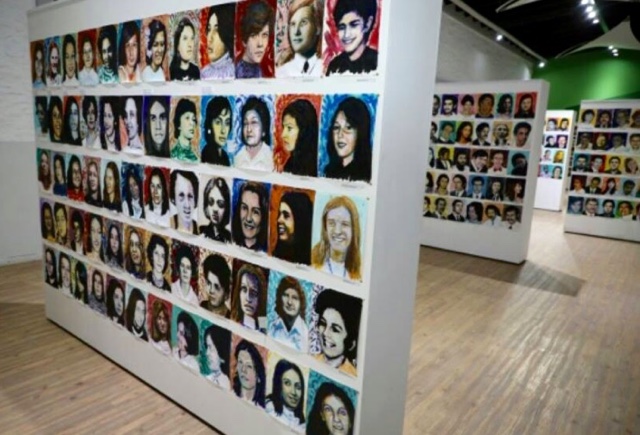
Brian Carlson: "Aparecidos (the Appeared)", 2015

Brian Carlson


Brian Carlson


Brian Carlson


Brian Carlson


Brian Carlson


Brian Carlson


Brian Carlson


Brian Carlson


Brian Carlson


Brian Carlson


Between 1976 and 1983, somewhere between 9,000 and 30,000 Argentinians “disappeared” in the so-called “National Reorganization Process,” or  what is more commonly known as "the Dirty War." The reigning military junta took people they considered political dissidents, brought them to detention centers, and then tortured and killed them.

The journey to healing from this tragedy has been a long road that has yet to reach its end.  Military officials are still being prosecuted, while memorials to the lost are finally being made.  As it happens, one of the people working on the memorial lives in Ozaukee County, Wisconsin -- Brian Carlson.

"The tour of ESMA,” Carlson said, “was profoundly moving to me. In these spaces, nearly 5000 human beings, following abductions, had been tortured, held in the worst circumstances and then taken to be executed. I haven’t been to Auschwitz, but this is Argentina’s Auschwitz. I promised the disappeared that I would respond with a memorial and return to exhibit it, if possible, in that space.”

Carlson held true to his promise. He began to paint the portraits of the Disappeared and, as the portraits began to fill his studio walls, they created a “garden of memory.” Carlson could see the possibility of what the portraits could do. He entitled his project "Aparecidos (the Appeared)." He wanted to, symbolically, bring back the people who had disappeared -- to ensure that they would not be forgotten, and that their lives may serve to warn people everywhere of what can happen when governments are allowed to oppress freedom.

“The opening of my exhibit at the Museo de Memoria in Rosario,” Carlson says, “was the most incredible experience I have had in 35 years of professional art. To see members of the Madres de la Plaza looking at the faces of their lost ones, wearing their traditional white scarves; to have an overflow, standing-room-only crowd of guests -- most of them relatives of the disappeared, and many relatives of victims I had painted; to be thanked by so many for work that has been an honor for me to do -- is something I can’t describe.”

Aside from some professional development grants and the generosity of Argentinians who have welcomed him into their homes, Carlson does his work without any funding.  He paints every day of the week, but the schedule and finances are not as draining as the emotional aspect of painting the portraits.

“I believe Aparecidos and its mission will spread and contribute to the decades of courageous human rights efforts in the involved countries,” says Carlson. “The message is memory, truth, justice and the sanctity of human life. It’s a critical message.”


Thursday, May 31, 2018

Edouard Boubat: Peace Correspondent

Edouard Boubat


Edouard Boubat


Edouard Boubat


Edouard Boubat


Edouard Boubat


Edouard Boubat was born in Montmartre, Paris. He studied typography and graphic arts at the École Estienne and worked for a printing company before becoming a photographer. 

In 1943 he was subjected to service du travail obligatoire, forced labor of French people in Nazi Germany, and witnessed the horrors of World War II. 

He took his first photograph after the war in 1946 and was awarded the Kodak Prize the following year. He travelled the world for the French magazine Réalités, where his colleague was Jean-Philippe Charbonnier, and later worked as a freelance photographer. 

French poet Jacques Prévert called him a "peace correspondent" as he was humanist, apolitical and photographed uplifting subjects. His son Bernard Boubat is also a photographer.


Thursday, April 26, 2018

Hit or Myth: Myth-Making and Myth-Busting

David Bates art and Roger Daltry of the WHO


A few years back, I was at a David Bates opening at Talley Dunn Gallery in Dallas, and I remarked to David that this sculpture reminded me of a rock 'n' roll singer with a microphone. He immediately said, "Thanks. You just ruined it for me." He had based this primordial image on a "nature man" wrestling with a snake. He was in deep, deep, deep into his MYTH-MAKING phase, while I was still in our previous, shared MYTH-BUSTING mode of the seventies and eighties. We used to joke around about our art like that, all the time. But NOW it was a clear-cut moment of, "open mouth, insert foot." WHO are you? -- We won't get fooled again, no, no, no...

Monday, April 16, 2018

Charles Eames and Ray Eames


Charles Eames and Ray Eames


Charles Eames and Ray Eames


Charles Eames and Ray Eames


Charles Eames and Ray Eames


Charles Eames and Ray Eames


Charles Eames and Ray Eames


Charles Eames and Ray Eames


Wednesday, April 11, 2018

Bonjour, Monsieur Matisse

Henri Matisse


The artist's artist -- Henri Matisse -- continuing to create magnificent art even while in his sick-bed...

Monday, March 19, 2018

Memories of Mr. Judd

 DeForrest Judd


DeForrest Judd


DeForrest Judd


DeForrest Judd


DeForrest Judd


DeForrest Judd


Although I didn't take a class with DeForrest Judd, I did get to spend passing time with him, and I would solicit feedback from all of the art teachers when they had spare time. I respected them all. Mr. Judd was a very quiet-spoken unassuming man. He would usually listen to whoever was talking, and clean out his pipe by whapping it softly on the palm of his hand -- and sort of chuckle a nearly inaudible "heh-heh."

My friend Don Shields was acting as Mr. Judd's Graduate Student "teaching assistant." So one time during the course of a semester, Shields and his fellow Grad student, Brian Cobble, decided to take Mr. Judd over to our favorite dive bar -- the Lion's Pub -- and do some "day-drinking." We would often hoist a few there and the SMU poets and writers had their own tables. 

Anyway, much to their surprise, Mr. Judd proceed to spin adventurous yarns of his many exotic travels and completely "drink them under the table." He thoroughly enjoyed himself.


Saturday, March 17, 2018

DeForrest Judd

DeForrest Judd


DeForrest Judd


DeForrest Judd (1916-1993) 

Judd graduated from the Cleveland Institute of Art in 1938 and received a post-graduate scholarship to continue his studies at the Institute in 1939. 

From 1940 - 1942 Judd studied at the Colorado Spring Fine Arts Center under the center’s director, Boardman Robinson, and Texas artist, Otis Dozier. 

During World War II Judd served in the United States Army. His academic career as professor of painting, drawing, and design began in 1946 when he moved to Dallas to teach at Southern Methodist University and the Dallas Museum of Fine Arts. 

In 1967 Judd was promoted to full professor at SMU. He retired from the University in 1981. Judd continued to live in Dallas and devote his time to art until his death in 1992.

Judd’s work reflects his study of nature: mountains, lakes, rocks, flowers, cactus, Gulf Coast, and scenes of everyday life that were painted or drawn in a semi-abstract form that made bold use of color. 

Judd received numerous awards for his work, and while teaching at SMU his work was featured in many one-man shows in Texas including the Dallas Museum of Fine Arts (1946), Southern Methodist University (1950, 1965, 1969, 1981), Elizabet Ney Museum (1952), Sul Ross State College (1957), Texas Tech Museum (1959), Fort Worth Art Center (1962), and the Beaumont Museum of Art (1971). 

His work was also exhibited in art centers and museum exhibitions around the country including the Metropolitan Museum of Art (one of twelve artists selected for the exhibition American Painting Today, 1950), Denver Art Museum, Cleveland Museum of Art, Colorado Springs Fine Arts Center, and the Dallas Museum of Fine Arts. 

Judd’s work was also accepted into the permanent collections of the Cleveland Museum of Art, Colorado Springs Fine Arts Center, Dallas Museum of Fine Arts, and Southern Methodist University.