Showing posts with label portrait painting. Show all posts

Saturday, November 24, 2018

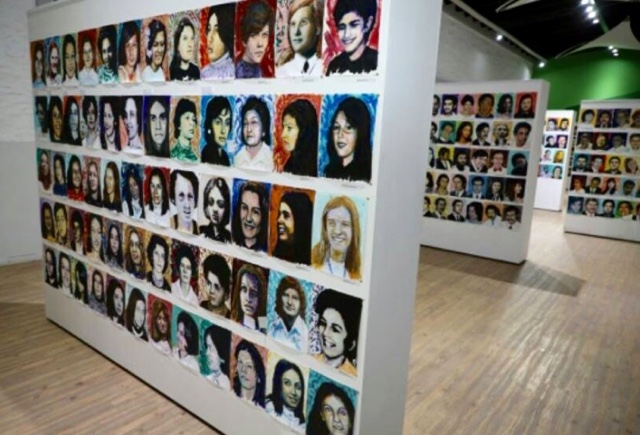
Brian Carlson: "Aparecidos (the Appeared)", 2015

Brian Carlson


Brian Carlson


Brian Carlson


Brian Carlson


Brian Carlson


Brian Carlson


Brian Carlson


Brian Carlson


Brian Carlson


Brian Carlson


Between 1976 and 1983, somewhere between 9,000 and 30,000 Argentinians “disappeared” in the so-called “National Reorganization Process,” or  what is more commonly known as "the Dirty War." The reigning military junta took people they considered political dissidents, brought them to detention centers, and then tortured and killed them.

The journey to healing from this tragedy has been a long road that has yet to reach its end.  Military officials are still being prosecuted, while memorials to the lost are finally being made.  As it happens, one of the people working on the memorial lives in Ozaukee County, Wisconsin -- Brian Carlson.

"The tour of ESMA,” Carlson said, “was profoundly moving to me. In these spaces, nearly 5000 human beings, following abductions, had been tortured, held in the worst circumstances and then taken to be executed. I haven’t been to Auschwitz, but this is Argentina’s Auschwitz. I promised the disappeared that I would respond with a memorial and return to exhibit it, if possible, in that space.”

Carlson held true to his promise. He began to paint the portraits of the Disappeared and, as the portraits began to fill his studio walls, they created a “garden of memory. Carlson could see the possibility of what the portraits could do. He entitled his project "Aparecidos (the Appeared)." He wanted to, symbolically, bring back the people who had disappeared -- to ensure that they would not be forgotten, and that their lives may serve to warn people everywhere of what can happen when governments are allowed to oppress freedom.

“The opening of my exhibit at the Museo de Memoria in Rosario,Carlson says, “was the most incredible experience I have had in 35 years of professional art. To see members of the Madres de la Plaza looking at the faces of their lost ones, wearing their traditional white scarves; to have an overflow, standing-room-only crowd of guests -- most of them relatives of the disappeared, and many relatives of victims I had painted; to be thanked by so many for work that has been an honor for me to do -- is something I can’t describe.”

Aside from some professional development grants and the generosity of Argentinians who have welcomed him into their homes, Carlson does his work without any funding.  He paints every day of the week, but the schedule and finances are not as draining as the emotional aspect of painting the portraits.

I believe Aparecidos and its mission will spread and contribute to the decades of courageous human rights efforts in the involved countries,” says Carlson. “The message is memory, truth, justice and the sanctity of human life. It’s a critical message.”


Sunday, May 7, 2017

Funerary Portrait of a Man: Second Century Realism


"Funerary Portrait of a Man," Egypt, Roman Empire, Antonine period, early Second century AD Encaustic on linen, Overall: 24.8 x 19 cm, Cleveland Museum of Art.

Wednesday, January 11, 2017

Jules Dahlager: Chief George Johnson Portraits


Jules B. Dahlager


Jules B. Dahlager


Chief George Johnson (d. 1938), or Gut Wain, or Koch Teech, Northern Northwest Coast Native American Chief of the Southeast Alaskan Tlingit Gaanaxadi clan. Born at Tongass Village (south of Ketchikan, Alaska), Johnson inherited the position of Chief in 1902, and became a wealthy man through trade with other Tlingit tribes.  

In the photo, Chief Johnson is depicted in profile wearing a carved wood crest hat of a "kadjuk," a mythological bird whom was the house crest of Chief Johnson's clan and who was said to amuse itself by dropping stones on hapless groundhogs. The image, a beautiful period photograph in its own right, was also the inspiration for many paintings by Alaskan artist Jules B. Dahlager.


Monday, February 29, 2016

Boris Chaliapin: Portrait of Thelonious Monk, TIME Cover, February 28,1964

Thelonius Monk by Boris Chaliapin


Thelonius Monk by Boris Chaliapin


A leader of the postwar jazz revolution, Thelonious Monk -- along with Dizzy Gillespie, and Charlie Parker -- sparked the "bebop" movement, a jazz style faster and more frenetic than the swing that had held sway since the thirties. Monk's piano style has been called eccentric -- "his melodies were angular, his harmonies full of jarring clusters."

Monk's recording career took off in the mid-1950s, and he won an enthusiastic following, often playing with such other avant-garde musicians as John Coltrane and Sonny Rollins. His compositions "Round Midnight," "Blue Monk," and "Epistrophy" are considered classics of modern jazz.

Jim Barber, historian at the National Portrait Gallery, recently discussed this portrait of Thelonious Monk by Boris Chaliapin at a Face-to-Face portrait talk. The portrait was created for Time magazine and appeared on the cover of the February 28, 1964 edition.

Catching Up with "Mr. TIME"
by Harry J. Weil 

The National Portrait Gallery spotlights the work of Boris Chaliapin, who created hundreds of magazine covers in lightning speed.

Sitters for Boris Chaliapin’s portraits recall his friendly demeanor and witty banter. When painting Julia Child for Time magazine, he’d take breaks to buy pickle juice for a Russian soup they prepared during their sessions. In the final piece, which appeared on the November 25, 1966 issue, the chef’s head floats on top of a crimson background surrounded by steaming pots and pans, cake molds, and a fish. One critic described it as resembling “the First Apparition in Shakespeare’s Macbeth.”

Chaliapin was Time’s most prolific artist, creating more than 400 cover images between 1942 and 1970. Twenty-six of his original paintings, most of which eventually appeared on the magazine’s cover, are now the focus of the exhibition “Mr. Time: Portraits by Boris Chaliapin,” opening May 17 at the National Portrait Gallery in Washington, D.C. Historian and curator James Barber selected the pictures from the gallery’s Time Collection of more than 2,000 works, which includes art by Jacob Lawrence and George Segal.

Earning the nickname “Mr. Time, Chaliapin executed likenesses at lightning speed, often in less than 12 hours. His realistic style included every mole and stray hair, and remained much the same throughout his career, even when Surrealism, Abstract Expressionism, and Pop Art were all the rage. He did, however, take some artistic liberties in his backdrops, adding details to reflect a subject’s occupation or personality.

Chaliapin came from a family of Russian virtuosos. His father, Feodor Chaliapin, was a renowned operatic basso, and his brother, Feodor, Jr., acted in Hollywood films. Boris had art training in Russia and Paris, and an exhibition in London before he began working for Time. His first commission for the magazine was of Indian independence leader Jawaharlal Nehru in 1942. Many more followed, including politicians (Harry S. Truman, Richard Nixon, Golda Meir) and celebrities (Marilyn Monroe, Elizabeth Taylor, Muhammad Ali).

The cover of Time was considered one of the last bastions of portrait painting in the American mainstream. The inclusion in the show of Chaliapin’s undated illustration Crime in the Streets, which depicts a murdered woman on an empty urban street, marks this end. That picture was never published, partly because the growing trend in journalism toward the end of Chaliapin’s career was to “use more photographs, less original art,” Barber says. “And for Time, they began publishing more covers that focused on issues, events, and topics—thus there were fewer portraits.


Wednesday, October 21, 2015

My Favorite Nathan Robinson Paintings


Nathan Robinson


Nathan Robinson


Nathan Robinson


Nathan Robinson


Nathan Robinson


Nathan Robinson


Nathan Robinson


I first saw some of Nathan Robinson's art in Dr. Stuart N. Robinson's office (his nephew). I was immediately struck by how very nice the landscapes were. You don't often see such fine art in a therapeutic setting -- it certainly helps me stay calm to see such "comfort art"...

Nathan Robinson (20th Century) was active/lived in Arizona. He's best known for his portrait, landscape, and figure painting.

Born in Richmond, Virginia, Robinson had his first art training at William and Mary College Extension Division. Later he attended the National Academy of Design in New York and studied privately with Dimitri Romanovsky, noted portrait painter. After three years in New York, he returned to Richmond and ran an art school for eleven years. Then, for the health of his son, he moved the family to Arizona where he was associated with the Desert House in Tucson.


Tuesday, September 29, 2015

An Edmond J. Fitzgerald Portrait Painting for my Collection

I was lucky enough to win at auction this fine portrait by family friend, Edmond J. Fitzgerald, for the unbelievable bargain price of $75. Needless to say, I was quite pleased by my good fortune.


Edmond J. Fitzgerald


Edmond J. Fitzgerald


Edmond J. Fitzgerald


Edmond J. Fitzgerald


Edmond J. Fitzgerald