Showing posts with label biography. Show all posts

Monday, July 30, 2018

On the Reading Table: "Tesla: The Wizard of Electricty" by David J. Kent

Nikola Tesla 


Nikola Tesla 


Nikola Tesla 


Nikola Tesla 


Nikola Tesla 


I'm reading the "companion volume" to the "Thomas A. Edison: Inventor of the Modern World" biography.

From its author, David J. Kent:

“This book is designed to appeal to general readers with a wide range of interests. 

Like thrilling personality insights? The book is chock full of interesting stories on Tesla from his '100-bug-powered' windmills as a youth to his practical jokes on Mark Twain in his heyday to his dispute with Albert Einstein as he entered his twilight years. 

Into graphic novels? 'Tesla: The Wizard of Electricity' includes many historical comics and photos to spotlight key events and figures in Tesla's spectacular life. The book is an amazing visual experience. 

An invention buff? The book captures the prolific inventive mind of Nikola Tesla and how many of his inventions were so far ahead of their time that we are still today relying on his patents for new discoveries. 

Turned on by conflict and tension? Tesla's life can be summed up by one of my chapter titles -- 'A Man Always at War.' Delve into the complex relationships he had with Thomas Edison, George Westinghouse, Guglielmo Marconi, J. P. Morgan, and others that were sometimes colleagues, and sometimes rivals. 

Prefer serious historical biography? 'Tesla: The Wizard of Electricity' traces the great man's life from his childhood in the military frontier, through his schooling and employment in the grand capitals of Europe, to his tumultuous, yet most productive, years in New York City, Colorado Springs, Chicago, Pittsburgh, and Niagara Falls. 

In short, the book provides insights into a man who has been largely ignored by history despite his huge contributions to modern life. A man who over 100 years ago anticipated that one day we would all be carrying around hand-held devices capable of instant communication across vast distances. Who a century ago promoted and developed renewable energy sources to replace fossil fuels. A man who left us a legacy that is just now being rediscovered by scientists, the public, and perhaps most ironically -- pop culture."

David J. Kent is the author of two books on Nikola Tesla -- "Tesla: The Wizard of Electricity" and an e-book, "Nikola Tesla: Renewable Energy Ahead of its Time."


Wednesday, February 27, 2013

The Magnificent Marvin, Again

I took this low-res iPad photo of the very small MDM painting in my Dallas apartment. The scene shows a tent campsite with a landed helicopter at the far right.


Coming to Alaska in 1947 not as a painter but as a geologist, Marvin Mangus spent many field seasons working for the U. S. Geological Survey in Northern Alaska and Canada. While mapping, exploring, and surveying for oil, he made the most of his access to remote, dramatic scenery by studying and painting the landscape. A solid figure on the Alaskan art scene for almost fifty years, Mangus received formal training in the early 1950s from such prominent artists as Eliot O'Hara, Roger Rittase, and William Walter. His record includes more than 50 solo exhibitions and several group exhibitions in Washington D. C., at the Corcoran Gallery of Art, the Smithsonian institution, and the Arts Club. He was one of the first artists to be awarded a solo exhibition at the Anchorage Museum of History and Art after it opened in 1969.

Most of Marvin Mangus' work balances lively brushwork and interest in painterly surface with the artist's profound respect for representational appearance.

Wednesday, June 20, 2012

A Salute to Rod Serling and Ray Bradbury

I'm pounding the computer keys up here at the fabulous Heritage Auctions Comic Art compound, so my blog posts for today will have to be consise. I'm trying to write at least one piece every day, just as the late great Ray Bradbury advised all authors, novice and seasoned, to do.

Ray Bradbury.

Speaking of Ray Bradbury, I always enjoyed his brand of poetic fantasy. Another master in this approach was famed Twilight Zone creator Rod Serling. Ray Bradbury got very peeved at Rod Serling for stealing his thunder, although Ray ended up writing at least one Zone episode. Other writers who mined this same rich vein of fantasy were Richard Matheson and his pal, Charles Beaumont, two more of my favorite fantasy writers.


Rod Serling in the Twilight Zone.

I've read two biographies on Serling. One was very favorable and positive, while the other was an unauthorized biography which put a negative spin on most of the key events Serling's life -- the feet of clay approach. Bah! This point of view didn't cut it for me. By most accounts, Serling was a fascinating, courageous, and supremely talented man.

Before he made a success of his writing career, Serling, a former WW II paratrooper who saw action in the Pacific Theater as a member of the 511th Parachute Infantry Regiment of the 11th Airborne Division Serling's Army combat service affected him deeply and also influenced much of his writing. His wartime combat experiences left Serling with nightmares and flashbacks which would plague him for the rest of his life. He was quoted as saying, "I was bitter about everything and at loose ends when I got out of the service. I think I turned to writing to get it off my chest." As a way to make some extra money throughout his college years, Serling took a part-time job testing parachutes for the Army Air Force. According to co-workers at the radio stations where he was also working, he received $50 for each successful jump. They recall Serling's telling them that he had once been paid $500, half before and half if he survived, for a hazardous test. His last test jump took place only a few weeks before his wedding. The pay was $1000 for him to test a newly invented jet ejection seat. Serling survived the test, but barely. Serling told friends later that three other men had been killed before he made the trial. Something went very wrong on one jump, and his wife had to pick up him from a bus station, carrying him like a dead weight because he was wrapped head-to-toe in thick bandages, and couldn't move for several days. Many times he faced down his fears.

I'm not 100% sure, but I think this was the better of the two biographies that I read:

Serling: The Rise and Twilight of Television's Last Angry Man by Gordon F. Sander

From Library Journal

"Rod Serling authorized only one person to pen his biography. However, the TV legend's anointed protege, Mark Olshaker, was so distraught over Serling's death in 1975 that he eventually turned the project over to Sander. Using these files and numerous interviews with Serling intimates, Sander has fashioned a vivid and fascinating portrait of this complex innovator from television's Golden Age. While not skimping on his analysis of Serling's famed masterpiece The Twilight Zone (1959-65), he also gives in-depth examinations of the making of such early TV classics as Requiem for a Heavyweight and Patterns . The five-time Emmy Award-winner's life is examined in detail. While always giving the pioneering TV writer/producer his due, Sander does not shirk from any of Serling's blemishes, including his eventual embrace of the crass commercialism in television that he initially opposed so vehemently. This excellent book is an essential purchase for public and academic libraries."- David M. Turkalo,


-- and this is the, to my mind, overly-critical, snarky biography:

Rod Serling: The Dreams and Nightmares of Life in the Twilight Zone/a Biography by Joel Engel

From the  Library Journal review:

"It is Joel Engel's thesis that Rod Serling's early live TV dramas, Requiem for a Heavyweight and Patterns , ecstatically received by the critics who pronounced Serling the Arthur Miller of TV, dogged Serling for the rest of his prolific career in TV, movies, stage, and prose. Driven by his twin fierce demons of ambition and insecurity, he became mired in the "velvet alley" of Hollywood, writing too fast (actually, dictating his scripts and rarely revising) on too many projects, so that The Twilight Zone (156 episodes, 1959-64, most of which he scripted) became his tomb. He ended his career in the knowing ignominy of commercials and game shows. If Serling never becomes the intended tragic figure in this unincisive but interesting first biography, still Engel is adept at dissecting the deficiencies of the scripts and revealing the extreme, often petty, censorship power wielded by networks and especially sponsors and ad agencies in the so-called "Golden Age" of TV."  -- David Bartholomew

Rod enjoying one of the damn smokes that helped finish him.

Tuesday, June 5, 2012

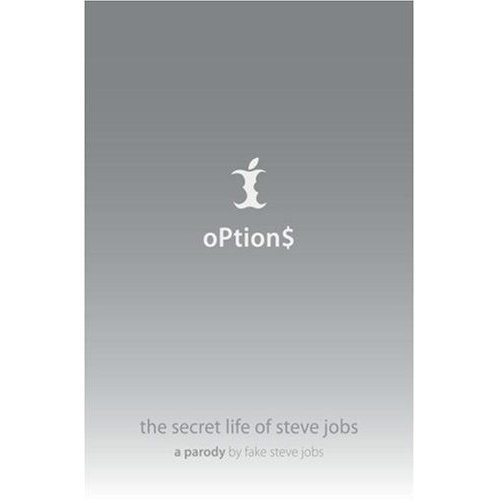
Options: The Secret Life of Steve Jobs - A Parody by Fake Steve Jobs

This parody is a riot. Read it.

"Welcome to the mind, to the world of Fake Steve Jobs. Fake Steve the counterintuitive management guru: “Obviously we can’t literally put our employees’ lives at risk. But we have to make them feel that way.” Fake Steve the political hobnobber: “I can see why they keep Nancy Pelosi under wraps. Wacky as a dime watch.” Fake Steve quoting friend/musician/philosopher Bono on road etiquette: “Tink about dat next toim yer cuttin off some bloke and you don’t know who it is, right? Could be Jay-sus. Or Boutros Boutros-Ghali or sumfin.” And on, yes, himself: “Geniuses have feelings, too.” In the tradition of Thank You for Smoking and in the spirit of The Onion, Options is a novelistic sendup and takedown of Silicon Valley, Hollywood, and Washington, D.C., as viewed by a central character who exists, to his immense self-satisfaction, at the crossroads of all three worlds: “It’s like in one of those movies where a guy realizes he’s got telekinetic powers and it’s just too bad if he doesn’t want them, he’s got them. Likewise, I have this gift. It’s who I am.”

In this parody of the life of Apple founder Steve Jobs, the pseudonymous Fake Steve Jobs (identified in the New York Times this month as Forbes senior editor Daniel Lyons) offers a gleeful sendup of the real Steve Jobs set amid the recent stock options backdating scandal. Throughout, the fake Steve pontificates on everything from his superior management skills (only promote stupid people) to his role in the development of the iPhone (it involves a lot of non-thinking meditation), and is portrayed as a cold, callow narcissist. Blissfully unaware of the legal firestorm raging around him, a mathlexic Fake Steve goes about his daily business, balancing meditation with the firing of employees while the Apple board of directors scrambles to avoid prison time and find a scapegoat. As the fictitious Apple corporation implodes, Fake Steve must decide whether to jump ship or stand by the company. Tech industry watchers who know (or know of) the players will get a kick out of seeing them skewered, but readers who aren't already tuned in to the Silicon Valley technocracy may not quite get it. Fake Steve doesn't really evolve as a character, but as a grotesque caricature, he's fun to watch."