Showing posts with label neuroscience. Show all posts

Tuesday, July 24, 2018

A. R. Luria: "The Mind of a Mnemonist"

A. R. Luria


I'm now catching up on my garage sale book-buy reading of last summer -- namely, the classic study of a memory "super-savant." The descriptions of the way "S." combines his synesthesia sensations to build a "memory palace" for his images is fascinating. (A. R. Luria studied Solomon Shereshevskii, a Russian journalist with a seemingly unlimited memory, sometimes referred to in contemporary literature as "flashbulb" memory, in part due to his five-fold synesthesia.)

"A welcome re-issue of an English translation of Alexander Luria's famous case-history of hypermnestic man. The study remains the classic paradigm of what Luria called 'romantic science, ' a genre characterized by individual portraiture based on an assessment of operative psychological processes. The opening section analyses in some detail the subject's extraordinary capacity for recall and demonstrates the association between the persistence of iconic memory and a highly developed synaesthesia. The remainder of the book deals with the subject's construction of the world, his mental strengths and weaknesses, his control of behavior and his personality. The result is a contribution to literature as well as to science.

Luria's essay is a model of lucid presentation and is an altogether convincing description of a man whose whole personality and fate was conditioned by an intellectual idiosyncrasy.

A distinguished Soviet psychologist's study...[of a] young man who was discovered to have a literally limitless memory and eventually became a professional mnemonist. Experiments and interviews over the years showed that his memory was based on synesthesia (turning sounds into vivid visual imagery), that he could forget anything only by an act of will, that he solved problems in a peculiar crablike fashion that worked, and that he was handicapped intellectually because he could not make discriminations, and because every abstraction and idea immediately dissolved into an image for him. It is all fascinating and delightful."

Thursday, July 12, 2018

Wednesday, June 20, 2018

Neural Circuit Taxonomy

Neural network circuits


Brain stuff -- interesting to find out what might go on in that grey matter.

"Precision psychiatry: a neural circuit taxonomy for depression and anxiety"

By Dr. Leanne M Williams, PhD
Summary

"Although there have been tremendous advances in the understanding of human dysfunctions in the brain circuitry for self-reflection, emotion, and cognitive control, a brain-based taxonomy for mental disease is still lacking. 

As a result, these advances have not been translated into actionable clinical tools, and the language of brain circuits has not been incorporated into training programs

To address this gap, I present this synthesis of published work, with a focus on functional imaging of circuit dysfunctions across the spectrum of mood and anxiety disorders. 

This synthesis provides the foundation for a taxonomy of putative types of dysfunction, which cuts across traditional diagnostic boundaries for depression and anxiety and includes instead distinct types of neural circuit dysfunction that together reflect the heterogeneity of depression and anxiety. 

This taxonomy is suited to specifying symptoms in terms of underlying neural dysfunction at the individual level and is intended as the foundation for building mechanistic research and ultimately guiding clinical practice."

And from Wikipedia:

"Dysfunction in the salience network have been observed in various psychiatric disorders, including anxiety disorders, post-traumatic stress disorder, schizophrenia, frontotemporal dementia, and Alzheimer's disease. 

The AI node of the salience network has been observed to be hyperactive in anxiety disorders, which is thought to reflect predictions of aversive bodily states leading to worrisome thoughts and anxious behaviors. 

In schizophrenia, both structural and functional abnormalities have been observed, thought to reflect excessive salience being ascribed to internally generated stimuli.

In individuals with autism, the relative salience of social stimuli, such as face, eyes, and gaze, may be diminished, leading to poor social skills."

Wednesday, June 13, 2018

Mini Book Review: Michael Pollan's "How to Change Your Mind"

Michael Pollan


I want to read this, but I don't want to spend much money. Since I don't read ebooks, a trip to the Loussac Library may be in order...

"The value of psychedelics is not the experience of them -- the grooviness of the moment -- but the sediment the experience leaves behind.

It’s possible these effects can be chalked up, in part, to the drug’s effect on the brain’s so-called 'default mode network,' especially the part associated with 'self-referential thought.' Pollan grants, if briefly, that turning off the network --truly 'getting over yourself' -- might also be achieved through 'certain breathing exercises,' or through 'sensory deprivation, fasting, prayer, overwhelming experiences of awe, extreme sports, near-death experiences, and so on.'

Pollan doesn’t give a lot of prime real estate to psychedelics’ naysayers. But given that those on LSD can appear to be losing their minds, and that the drug leaves one feeling emotionally undefended (a potential benefit as well as a profound risk), he does strongly recommend having an experienced guide in a proper setting when you trip. With those safeguards in place, he believes usage could be on the verge of more widespread acceptance, pointing out that plenty of other once widely-derided practices redolent of the 1960s, like yoga and natural birth, are now common."

Among other things, Pollan discusses the ways that psychedelics 'dissolve our sense of self,' and the potential mental health benefits they bestow as a result. “Psilocybin gives you such a powerful psychological experience that it kind of reboots your brain, your mind,” he says. “A lot of depression is a sort of 'self-punishment,' as even Freud understood. We get trapped in these 'loops of rumination' that are very destructive, and the stories that we tell ourselves: you know, 'that we’re unworthy of love, that we can’t get through the next hour with a cigarette,' whatever it is. And these deep, deep 'grooves of thought' are very hard to get out of. They disconnect us from other people, from nature, from an earlier idea of who we are. The 'mystical experience,' as it’s sometimes called, or the 'experience of the dissolution of the ego,' gets us 'out of those grooves' and gives us a break from 'the tyranny of the ego,' which can be a very 'harsh ruler.'”

Tuesday, June 12, 2018

Neuroscience: Default Mode Network


From yee Wiki: In neuroscience, the default mode network (DMN), also default network, or default state network, is a large scale brain network of interacting brain regions known to have activity highly correlated with each other and distinct from other networks in the brain.

The default mode network is most commonly shown to be active when a person is not focused on the outside world and the brain is at wakeful rest, such as during daydreaming and mind-wandering. But it is also active when the individual is thinking about others, thinking about themselves, remembering the past, and planning for the future. The network activates "by default" when a person is not involved in a task. Though the DMN was originally noticed to be deactivated in certain goal-oriented tasks and is sometimes referred to as the task-negative network,mit can be active in other goal-oriented tasks such as social working memory or autobiographical tasks.The DMN has been shown to be negatively correlated with other networks in the brain such as attention networks.

Evidence has pointed to disruptions in the DMN of people with Alzheimer's and autism spectrum.


The default mode network is known to be involved in many seemingly different functions:

It is the neurological basis for the self:

Autobiographical information: Memories of collection of events and facts about one's self
Self-reference: Referring to traits and descriptions of one's self

Emotion of one's self: Reflecting about one's own emotional state

Thinking about others:

Theory of Mind: Thinking about the thoughts of others and what they might or might not know

Emotions of other: Understanding the emotions of other people and empathizing with their feelings

Moral reasoning: Determining just and unjust result of an action

Social evaluations: Good-bad attitude judgments about social concepts

Social evaluations: Good-bad attitude judgments about social concepts

Social categories: Reflecting on important social characteristics and status of a group

Remembering the past and thinking about the future:

Remembering the past: Recalling events that happened in the past

Imagining the future: Envisioning events that might happen in the future

Episodic memory: Detailed memory related to specific events in time

Story comprehension: Understanding and remembering a narrative


The default mode network is active during passive rest and mind-wandering. Mind-wandering usually involves thinking about others, thinking about one's self, remembering the past, and envisioning the future.

Electrocorticography studies (which involve placing electrodes on the surface of a subject's scalp) have shown the default mode network becomes activated within a fraction of a second after participants finish a task.

Studies have shown that when people watch a movie, listen to a story, or read a story, their DMNs are highly correlated with each other. DMNs are not correlated if the stories are scrambled or are in a language the person does not understand, suggesting that the network is highly involved in the comprehension and the subsequent memory formation of that story. The DMN is shown to even be correlated if the same story is presented to different people in different languages, further suggesting the DMN is truly involved in the comprehension aspect of the story and not the auditory or language aspect.

The default mode network has shown to deactivate during external goal-oriented tasks such as visual attention or cognitive working memory tasks, thus leading some researchers to label the network as the task-negative network. However, when the tasks are external goal-oriented tasks that are known to be a role of the DMN, such as social working memory or an autobiographical task, the DMN is positively activated with the task and correlates with other networks such as the network involved in executive function.

A hitherto unsuspected possibility is that the default network is activated by the immobilization inherent in the testing procedure (the patient is strapped supine on a stretcher and inserted by a narrow tunnel into a massive metallic structure). This procedure creates a sense of entrapment and, not surprisingly, the most commonly reported side-effect is claustrophobia. This alternative view is suggested by a recent article that links theory of mind to immobilization.

Thursday, February 16, 2017

On the Reading Table: "Quiet" by Susan Cain

Susan Cain

This popular book got rather a lukewarm review from a New York Times books critic, but since I have a copy on hand, I'm reading it anyway.

Update: I finished reading it, and thought it rather good. Well worth reading for an introvert or those on the "autism spectrum."

Friday, November 27, 2015

Signs that You May Be a "Highly Sensitive Person"

By Sammy Nickalls

People say you’re emotional, but maybe you just feel things. There’s nothing wrong with being a sensitive creature, in fact there’s a lot to be said for it. But it comes with its own highs and lows. Some highly sensitive people—a term coined by Dr. Elaine Aron— tend to feel lonely because many people can’t relate to the way they operate. 

However, many more people are HSPs than you’d think. Psychology Today reports that one out of five people can be considered “highly sensitive.” “This trait reflects a certain type of survival strategy, being observant before acting,” writes Dr. Aron.The brains of highly sensitive persons (HSPs) actually work a little differently than others”

Think you may be an HSP? Check out these signs. And if most of them apply to you, then welcome to the club -- we don’t have jackets, but we’ve got tissues and a lot of feelings.

You feel all the feelings

Your emotions are vivid -- practically palpable. You can be moved easily, whether that’s through a play, a movie, a book, or simply an interaction on the street.

You can often tell what someone’s feeling, or when something’s wrong with those you love.

HSPs tend to be highly intuitive. (Actually, in Dr. Aron’s research she found at 20 percent of the population reacts strongly to other people’s emotional circumstances.) Since you’re so in tune with your feelings, you can also pick up on the feelings of those you love. When your friend says they’re okay, you can see through that, and often end up saying, “Please, really, tell me what’s wrong. You know you can trust me.”

You tend to prefer exercising on your own.

Highly sensitive people may tend to avoid team sports, where there’s a sense that everyone is watching their every move,” according to the Huffington Post. Even if you’re very into fitness, you didn’t join team sports as a kid because you felt like everyone was watching or judging you. Even going to a gym when it’s somewhat full can intimidate you. The most ideal workout for you is in the comfort of your own living room.

 Or really, just working on your own in general.

The thought of working from home is wonderful to you. You get to control the environment, and you find that you work best that way. But if you have to work in an office, you much prefer having your own cubicle. According to researcher Ted Zeff, who spoke with the Huffington Post, cubicles -- as opposed to bullpen-type environments -- provide that extra little bit of privacy an HSP needs to feel productive. 

You’re very polite.

According to Salon, HSPsoften have particularly good manners, and notice when others don’t.” You always notice when people say “please” and “thank you,” and you always make sure to say them yourself. Deep down, you’re afraid of offending people, so you make sure to always mind your manners until you feel 100% comfortable with someone -- and even then, you’re still polite. 

In fact, you’d describe yourself as a “people pleaser.”

The thought of criticism is terrible to you. You often go to great lengths to avoid it. This leads to people-pleasing, and trying your hardest to always make sure everyone likes you and is happy with you. “You know why I do that? Why I try so hard not to inconvenience people? It’s to prevent them from feeling like Idid inconvenience them,” writes Kelly, an HSP blogger. “I’m so afraid that people will think I am annoying, I go out of my way to make sure they don’t feel that way.”

For that reason, it’s very difficult for you to say “no” to anything.

You sometimes are so afraid of hurting or offending someone that you find yourself saying “yes” to everything, even when you would strongly prefer not to. For example, you may find yourself helping out at an event when you’re feeling exhausted, or agreeing to pick someone up at the airport when you already had plans.

You take ages to make decisions -- no matter how small.

You know that mildly uncomfortable feeling everyone gets after realizing they made the wrong decision on something minor? Yeah, you get that, too—but times ten. Even if it’s something as small as an ice cream flavor, you get it bad. For that reason, you tend to take ages to make decisions, because you want to be positive that it’s the right one. You mull it all over and even envision how you would feel if you chose each route.

You’re incredibly observant.

You’re very much a detail-oriented person. You notice every little nuance.You tend to find yourself overwhelmed (in a good way) by simply being outdoors, especially during seasonal changes. You notice how the sun shines through the leaves making them a brighter hue, or how the air has become slightly colder as summer turns to fall. Combine those observant tendencies with your intuition and emotional intelligence, and you can always notice if someone’s being genuine or not.

You’re a bit of a perfectionist.

Because you’re such a detail-oriented person, you notice mistakes much faster than others. You tend to be a perfectionist in many things you do, especially if you work in a field you’re passionate about.

You tend to react more than most people.

If something happens -- the phone rings, there’s a knock at the door, someone asks an abrupt question -- you often find yourself the first to respond. This also happens with anything regarding emotion. You wouldn’t describe yourself as dramatic, but you feel everything stronger, and that makes you react stronger in turn. “Most people have a reaction when seeing an accident but for some highly sensitive people the effect can be dramatic and long lasting,” writes HSP blogger Edward Mills.

You’re not afraid to let the tear ducts take over.

You cry at happy movies. You cry at sad movies. You just cry. It’s common for HSPs, according to Aron’s HSP newsletter, The Comfort Zone. To you, crying isn’t always a sign of despair -- it’s a sign of being alive.

People often look down on your for your emotional tendencies, or tell you “not to take things so seriously.”

You’ve had people, especially very logical people, be rather surprised at your reactions, because they can’t connect.

But your loved ones take a different route.

Your loved ones know that you’re emotional, and when you’re upset, they often tell you not to worry, because “it’s just not worth it” (though they know you’ll continue to be upset until you calm yourself down). On the other hand, if you’re happy crying, they just giggle and pat you on the back.

You have a lower pain tolerance than most people you know.

You fear pain, like getting your blood drawn, more than most. What other people may find just painful, you may find excruciating. “Headaches, muscle and joint pains, and general malaise are all indicators the body sends out that change is needed, and HSPs are more prone to pay attention, rather than just shrug something off or take a couple of aspirins,” according to the HSP website.

You scare kind of easily.

You’re more sensitive to violence and frightening situations, even in movies. Since you can vividly picture what it would be like, you can connect to the characters on an emotional level, making it far scarier for you. “I am highly sensitive to violence and horror,” writes HSP blogger, Kelly. “I learned early in life that I don’t want anything to do with scary movies. Friends would sometimes tease me and try to convince me to watch, thinking it was not a big deal. But having disturbing scenes burned into my brain for life is a big deal.

No one really likes loud, annoying noises, but you hate them.

That static on the radio when you have a bad signal, the baby screaming next to you, the car alarm down the street -- everyone’s annoyed by them, but you let them fill your head. You feel the extreme need to either quiet the noise or get away from it as soon as possible. (There’s a whole section on dealing with noise on the HSP website.)

You also hate bright, fluorescent lights.

You prefer cozy, dimmer lighting because it’s easier on your eyes. The harsh lights are just too much for you to handle. In general, anything that is extreme on the senses is often too much for you.

You’re super-creative.

You can think outside the box. Your mind seems to work in a different way than most. You have a passion for a creative hobby, like painting, music, or writing. Your capacity to pay attention to every sensory detail fosters a super-creative side, according to Psychology Today. 

You’re not the only one in your family who’s highly sensitive

Sensitivity is an inherited trait,” Dr. Aron told the Utne Reader.

You struggle with taking care of your body

[HSPs] often put off things like taking proper breaks, exercising, making it a point to eat a healthy, balanced meal or may even skip a meal because they don’t have time right now,” according to the website for Highly Sensitive People. Because your sensitivity may extend to certain foods or physical maladies, it’s important to prioritize your health and make time for eating properly and exercising. 

You tend to like things “before they’re cool.”

Your intuitive nature tends to make you appreciate and recognize things faster than most, making you the ultimate tastemaker.


Sunday, October 25, 2015

Recommended Bill Moyers DVD Set: Moyers On Addiction: Close to Home


I picked this two-DVD Bill Moyers set up at the used bookstore at a bargain price -- one dollar. Sure, why not check it out? Upon viewing this material, the neuroscience, psychology of emotions, and the social aspects of healing addiction seem to have much in common with severe anxiety disorder treatment.

This set is well worth watching for an understanding of treating these widespread chronic problems that can relapse. Five in-depth episodes, plus bonus materials.

"Moyers on Addiction: Close to Home"

This five-part series takes a look at the science, treatment, prevention, and politics of addiction. The compulsive need for alcohol, nicotine and illegal drugs affects people of every class, race, and profession. Few Americans have been spared its impact -- either directly or through a friend, co-worker or loved one. Despite its prevalence, there is no clear picture of addiction in America. Hoping to raise awareness about this issue, Moyers reports on a disease that has affected his own family as well as millions of Americans. (1998)

"The Hijacked Brain"
March 29, 1998 | Moyers on Addiction: Close to Home
Bill Moyers attempts to unravel the mysteries of the addicted mind.

"Portrait of Addiction"
March 29, 1998 | Moyers on Addiction: Close to Home
Nine men and women -- all recovering from drug and/or alcohol addiction -- tell their stories. Their candid testimony leaves no doubt that addiction can happen to anyone -- and so can recovery.

"Changing Lives"
March 30, 1998 | Moyers on Addiction: Close to Home
BIll Moyers visits innovative treatment programs, including the one that helped his son.

"Next Generation"
March 31, 1998 | Moyers on Addiction: Close to Home
Addiction is a cycle, passing from generation to generation. Many anti-drug programs have little effect, but there's still hope for children.

"The Politics of Addiction"
March 31, 1998 | Moyers on Addiction: Close to Home
Moyers talks with people working to change American drug policy from a criminal-justice approach to a public-health model.


Sunday, October 11, 2015

Brain Pickings Weekly - Book Review: The Balance Within: The Science Connecting Health and Emotions

Stress and the Social Self: How Relationships Affect Our Immune System

“We are all tethered to our social worlds by invisible but steel strong wires.”

Relationships, Adrienne Rich argued in her magnificent meditation on love, refine our truths. But they also, it turns out, refine our immune systems. That’s what pioneering immunologist Esther Sternberg examines in The Balance Within: The Science Connecting Health and Emotions (public library) — a revelatory inquiry into how emotional stress affects our susceptibility to burnout and disease.
As just about every socialized human being can attest, interpersonal relationships play a significant role in our experience of stress — either contributing to it and or alleviating it. And the way we connect — something psychologist Barbara Fredrickson has termed “positivity resonance” — is deeply patterned through our earliest experiences of bonding, which train our limbic pathways. Sternberg traces the cognitive origin of these formative patterns:
Somewhere in our brains we carry a map of our relationships. It is our mother’s lap, our best friend’s holding hand, our lover’s embrace — all these we carry within ourselves when we are alone. Just knowing that these are there to hold us if we fall gives us a sense of peace. “Cradled,” “rooted,” “connected” are words we use to describe the feeling that comes of this knowledge; social psychologists call this sense embeddedness. The opposite is perhaps a more familiar term — we call it loneliness.
Thus a person, sitting by herself in a room, may appear to others to be quite alone; but that person, if embedded, will have a world of relationships mapped inside her mind — a map that will lead to those who can be called on for nurture and support in time of need. But others, the Gatsbys among us, might be among a crowd of dozens and yet feel very much alone. Many pieces of great literature have in fact tapped into this sense of disconnectedness. Our sense that powerful forces beyond our bodies link us to others is so ingrained that we use phrases such as “times that bind,” “family dyes,” and “bonding,” to describe those intangible connections. And the emotions they evoke are among the greatest forces that affect our hormonal, our nerve chemical, and our immune responses — and through these, our health and our resistance to disease.

Illustration by Maurice Sendak for ‘Open House for Butterflies’ by Ruth Krauss. Click image for more.

We encode these emotions early and carry them forward through symbol and ritual, using physical experiences and objects as memory-anchors. Sternberg captures the enduring echoes of these primal patterns:
A very young child will carry a physical reminder of mother’s embrace: a security blanket, a favorite toy, something soaked with all the smells of home and love… The engagement ring and wedding band have the power in an ounce of gold to evoke the memory of the beloved… We are all tethered to our social worlds by invisible but steel strong wires.
And yet, however deeply engrained these patterns may be, relationships are also inherently alive — they grow, change, and invariably become what Leo “Dr. Love” Buscaglia memorably termed a process of “dynamic interaction.” In a passage that calls to mind David Whyte’s wisdom on endings and beginnings, Sternberg examines the often inevitable evolution — and sometimes revolution — of relationships:
A relationship is built of strings of moments that our mind has pulled out from where they were stored in memory, moments and memories that come with emotions attached. Memories, spliced together like this in a seamless thread, make a relationship seem continuous and whole. So, after not seeing a childhood friend for years, we can pick up where we left off, as if no time at all had intervened. In this way, too, relationships can be sustained in thought during long absences — parents away from adult children, long-distance lovers, commuting husbands and wives. But the same capacity of the brain to forge this chain of memory can lead to difficulties in a relationship if one member evolves past where the other’s memory left off. So, a child leaving home for college, who left still on the verge of adulthood and returns an independent adult, will encounter a parent’s resistance when the person who steps back into the parent’s memory is not the same as the one who left. It takes a period of adjustment on both sides to set the chain evolving back on a new course.
[…]
At times, one small corner of that map can swell and grow, reverberate and suddenly seem to take over our entire world: we fall in love; we are abandoned; we become envious; we hate. The persons who are the object of such feelings can take on gigantic proportions in our minds and dominate our whole social and emotional outlook, coloring every corner of our lives, until, through monumental effort, or simply through gradual erosion of time, they recede again to their rightful place and size.

Art by Andrea Dezsö for a special edition of the Brothers Grimm fairy tales. Click image for more.

These fluid social dynamics, Sternberg points out, permeate our culture well beyond our immediate individual experience:
The social world can activate the stress response, or it can tone it down. The effects of these personal connections can be more soothing than an hour of meditation. They can also be as stressful, and more long-lived, as running at top speed for twenty minutes on a treadmill. In fact, of all the sensory signals that impinge on us from moment to moment throughout the day, it is the ones connected in some way to another person that can trigger our emotions most intensely. If emotions are really meant to move us, it is these bonds toward which they push or from which they pull. Whole industries are based on the power of such social bonds: romance novels, movies, cosmetics, fashion, advertising, popular songs. In one way or another, the whole of our popular culture strives toward sealing or healing these social connections.
And heal we must, for the social self is central to our neurobiological experience of stress:
It seems that social conflict brings out an additional and unique hormonal response that is not stimulated by other forms of stress. This unique pattern of hormonal stress response predisposes socially stressed mice to herpes infection. The hormone that does this, which is secreted in saliva, is called nerve growth factor. Those who are prone to herpes virus “cold sores” will find this situation all too familiar. It is exactly when we are stressed — perhaps with lack of sleep and too much work, but especially with prolonged anxiety over personal or workplace situations — that we invariably get a cold sore.

Esther M. Sternberg M.D.: The Balance Within


From the Amazon listing:

The immune system was long believed to be autonomous -- unconnected to the brain; Sternberg, a neuroscientist at the National Institute of Mental Health, focuses here on research done over the last few decades that disproves this belief. 

She methodically details the history of this science -- describing, for example, the Nobel prize-winning work of three French scientists who, in 1958, discovered the "interleukins" (molecules that signal between cells), which led to further investigations into how immune cells communicate with the brain, and discussing the seminal but controversial work of Hans Selye, who in the 1950s explored the body's response to stress. 

Although Sternberg leavens her account with anecdotes and historical snapshots of early medical treatment, her litany of scientific experiments (mostly performed on rats) into the body-mind connection may overwhelm readers without any scientific background. 

Of greater interest are her reflections on the implications of this research for maintaining health and treating disease. 

According to Sternberg, physical and psychological stresses -- such as prolonged lack of sleep, divorce or social isolation -- can make people sick by adversely affecting their immune and hormonal responses. 

Conversely, a strong belief in healing rituals and prayer may help make them well (via the placebo effect). All in all, Sternberg is optimistic about the idea of bridging disciplines to develop new treatments for disease.

The director of the Molecular, Cellular, & Behavioral Interactive Neuroscience Program at the National Institutes of Health gives us one of the best recent books on emotions and health

Sternberg effectively draws on her ample research and clinical experience to provide detailed descriptions of the interrelationships of the immune, nervous, and endocrine systems and how they in turn relate to emotions and the body

Into her clear scientific exposition, she folds the lives and works of such fascinating researchers as Wilder Penfield and Hans Selye. She has the personal touch, as when she stresses the importance of face-to-face communication and contrasts it to the impersonal aspects of Internet communication

She has a feeling for place and vividly depicts Montreal and other settings. Finally, in her citation of medical cases, she enlightens and stimulates, as, for example, when in recalling a classic case of alert perception, she reveals the importance of total-body tattoos in the study of the lymphatic system. 

Monday, August 31, 2015

On the Reading Deck: David J. Linden: Touch, The Science of Hand, Heart, and Mind


Johns Hopkins neuroscientist and bestselling author of The Compass of Pleasure David J. Linden presents an engaging and fascinating examination of how the interface between our sense of touch and our emotional responses affects our social interactions as well as our general health and development. Accessible in its wit and clarity, Touch explores scientific advances in the understanding of touch that help explain our sense of self and our experience of the world.

From skin to nerves to brain, the organization of the body’s touch circuits powerfully influences our lives—affecting everything from consumer choice to sexual intercourse, tool use to the origins of language, chronic pain to healing. Interpersonal touch is crucial to social bonding and individual development. Linden lucidly explains how sensory and emotional context work together to distinguish between perceptions of what feels good and what feels bad. Linking biology and behavioral science, Linden offers an entertaining and enlightening answer to how we feel in every sense of the word.

About the Author

DAVID J. LINDEN is a professor of neuroscience at the Johns Hopkins University School of Medicine and the New York Times bestselling author of The Compass of Pleasure and The Accidental Mind. He lives in Baltimore with his two children.

From the Brainpickings Newsletter: Oliver Sacks

Oliver Sacks on Storytelling, the Curious Psychology of Writing, and What His Friendship with the Poet Thom Gunn Taught Him About Creativity and Originality

by 
“The act of writing is an integral part of my mental life; ideas emerge, are shaped, in the act of writing… a special, indispensable form of talking to myself.”
Who we are and who we become is in large part the combinatorial product of the people and ideas we surround ourselves with — what William Gibson so memorably termed our“personal micro-culture” and Brian Eno called“scenius.” The more different those people are from us, the more they expand the echo chamber of our own mind, the more layered and beautiful the symphony of the spirit becomes. Nowhere is this self-expansion via relationship more evident than in the friendships between great artists and great scientists, one of the most heartening examples of which is the friendship between legendary neurologist Oliver Sacks and the poet Thom Gunn.
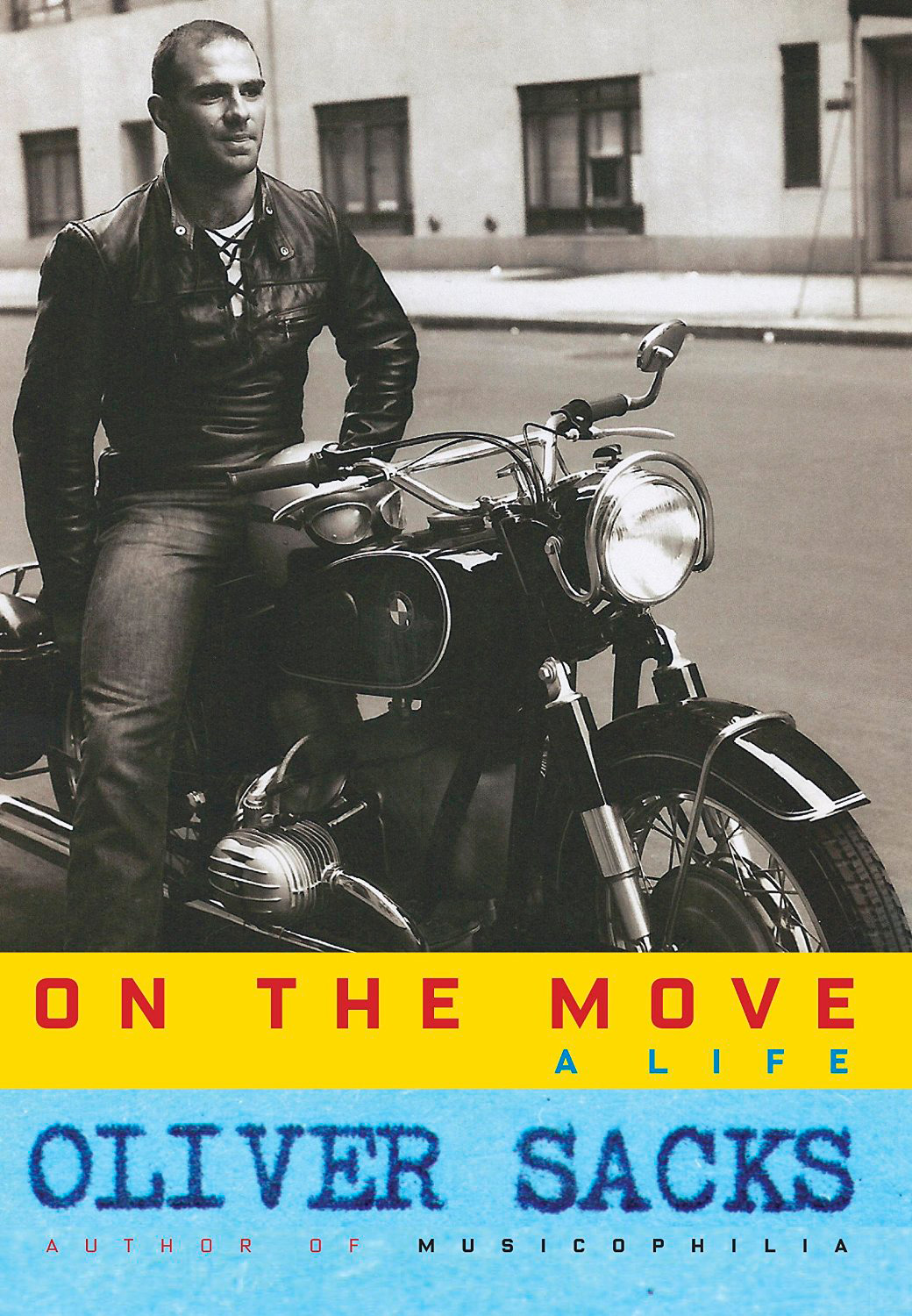
In On the Move: A Life (public library) — the immeasurable and incompressible rewards of which I have previously extolled at great length and with great love— Dr. Sacks, a Thoreau of the mind, recounts how his relationship with Gunn shaped his own evolution as a writer. In fact, his very autobiography is titled after Gunn’s poem “On the Move” from his 1959 collection Sense of Movement.
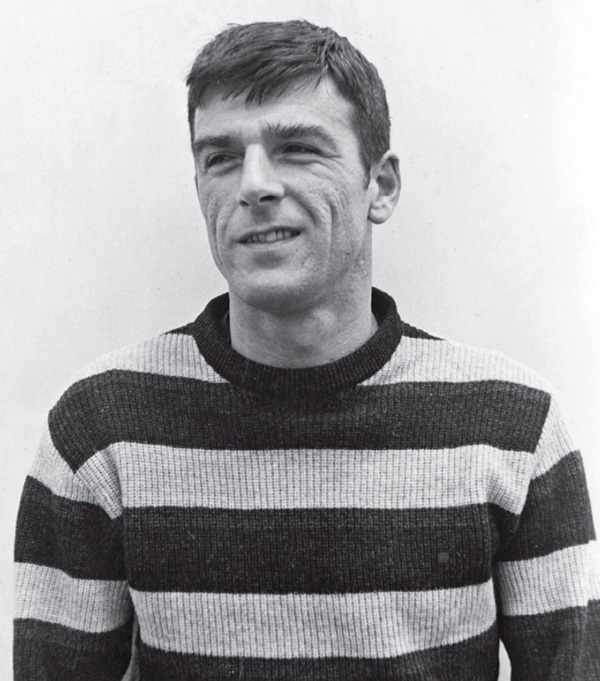
Thom Gunn in the early 1960s, around the time Dr. Sacks met him (Courtesy of Oliver Sacks)
To be sure, Sacks’s love affair with writing predates his meeting Gunn and even his foray into science. Nicknamed Inky as a boy for his voracious appetite for pen and paper, which covered everything in ink, he began journaling at an early age — a formative practice of learning to think on paper and converse with himself. Joining the extensive roster of celebrated writers who championed the creative benefits of keeping a diary and speaking to the potency of journaling as an antidote to Tom Waits’s complaint about the inopportune timing of the muse, Sacks writes:
I started keeping journals when I was fourteen and at last count had nearly a thousand. They come in all shapes and sizes, from little pocket ones which I carry around with me to enormous tomes. I always keep a notebook by my bedside, for dreams as well as nighttime thoughts, and I try to have one by the swimming pool or the lakeside or the seashore; swimming too is very productive of thoughts which I must write, especially if they present themselves, as they sometimes do, in the form of whole sentences or paragraphs…
But for the most part, I rarely look at the journals I have kept for the greater part of a lifetime. The act of writing is itself enough; it serves to clarify my thoughts and feelings. The act of writing is an integral part of my mental life; ideas emerge, are shaped, in the act of writing.
My journals are not written for others, nor do I usually look at them myself, but they are a special, indispensable form of talking to myself.
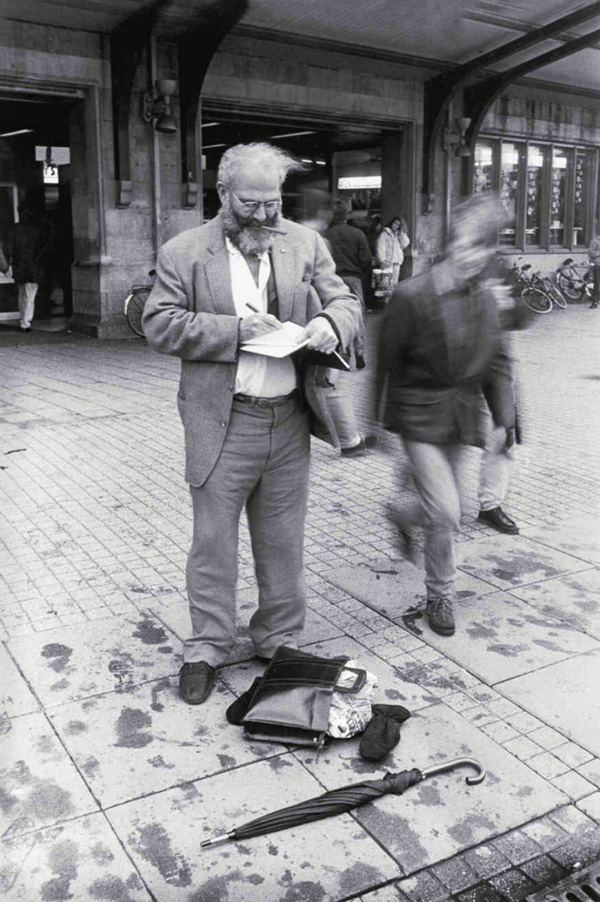
Dr. Sacks captures a thought in his journal at Amsterdam's busy train station (Photograph: Lowell Handler)
He adds:
The need to think on paper is not confined to notebooks. It spreads onto the backs of envelopes, menus, whatever scraps of paper are at hand. And I often transcribe quotations I like, writing or typing them on pieces of brightly colored paper and pinning them to a bulletin board.
What Sacks is describing is akin to a commonplace book — that Medieval Tumblr in which thinkers recorded quotations and ideas from whatever they were reading, assembling a personal archive of the ideas that shaped their own minds. (Brain Pickings is essentially one giant commonplace book, and this very piece a sort of bulletin board pinned to which is my discourse with Sacks’s extraordinary text.)
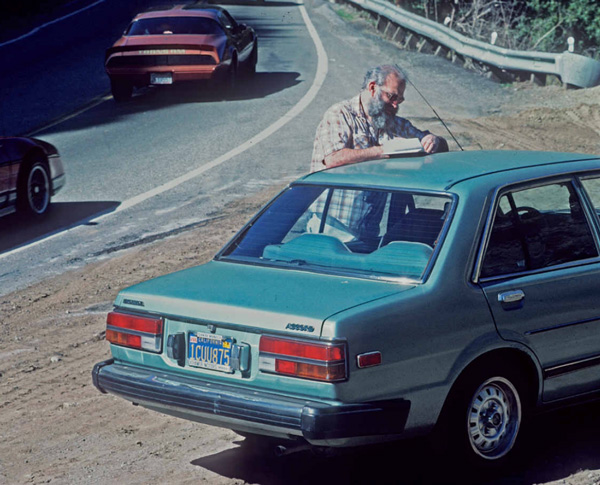
Another thought recorded atop a car roof on the side of the road (Courtesy of Oliver Sacks)
By the time he was in graduate school, Sacks began externalizing these inner conversations, doing for others what he had been doing for himself on the pages of his journals — clarifying the complexities of mental life at the intersection of science and storytelling, honing the singular gift for which he is so beloved today.
He was so electrified by working with patients at a migraine clinic in the mid-1960s that he felt compelled to transmute these insights into a book. But when he finally finished the manuscript and showed it to his boss at the clinic — a prominent but petty and egomaniacal neurologist by the name of Arnold P. Friedman — he was curtly told that the manuscript was garbage, that he had to destroy it, and that he dare not think about turning it into a book ever again; or else, Friedman threatened, Sacks would be promptly fired and barred from getting another job anywhere in America. Friedman confiscated the manuscript and locked it away.
Still, Sacks trusted that he had written something substantive and important — something that might forever change our understanding of how the mind works. He suppressed his feelings for months but, finally, the resentment exploded into action: One night, with the help of the clinic’s janitor, he sneaked in and, between midnight and 3 A.M., arduously copied his own notes by hand. The next day, he told Friedman he was taking a long leave to London and when his boss demanded a reason, Sacks responded that he had no choice but to write the forbidden book.
He was fired via telegram a week later. And yet a strange sense of liberation set in, which he poured into the writing.
But if this wasn’t courageous enough an act, he soon performed what is perhaps the greatest act of creative courage — the same one John Steinbeck had performed three decades earlier in destroying a manuscript he didn’t feel was good enough and rewriting it from scratch into what would become his Pulitzer-winning novel The Grapes of Wrath, the cornerstone of his Nobel Prize. Sacks recounts:
I was dissatisfied with my 1967 manuscript and decided to rewrite the book. It was the first of September, and I said to myself, “If I do not have the finished manuscript in Faber’s hands by September 10, I shall have to kill myself.” And under this threat, I started writing. Within a day or so, the feeling of threat had disappeared, and the joy of writing took over. I was no longer using drugs, but it was a time of extraordinary elation and energy. It seemed to me almost as though the book were being dictated, everything organizing itself swiftly and automatically. I would sleep for just a couple of hours a night. And a day ahead of schedule, on September 9, I took the book to Faber & Faber. Their offices were in Great Russell Street, near the British Museum, and after dropping off the manuscript, I walked over to the museum. Looking at artifacts there — pottery, sculptures, tools, and especially books and manuscripts, which had long outlived their creators — I had the feeling that I, too, had produced something. Something modest, perhaps, but with a reality and existence of its own, something that might live on after I was gone.
I have never had such a strong feeling, a feeling of having made something real and of some value, as I did with that first book, which was written in the face of such threats from Friedman and, for that matter, from myself. Returning to New York, I felt a sense of joyousness and almost blessedness. I wanted to shout, “Hallelujah!” but I was too shy. Instead, I went to concerts every night — Mozart operas and Fischer-Dieskau singing Schubert — feeling exuberant and alive.
Sacks’s jubilant intuition wasn’t misplaced — that manuscript became his 1970 debut Migraine, which was welcomed with wholehearted critical acclaim and catapulted him into the status of masterful science storyteller. When the book came out, he found out that Friedman had adapted the original manuscript and attempted to publish it under his own name — a tragicomic testament to the fact that it is Sacks’s singular gift as a writer and storyteller, not his scientific genius alone, that make him the cultural icon he is today.
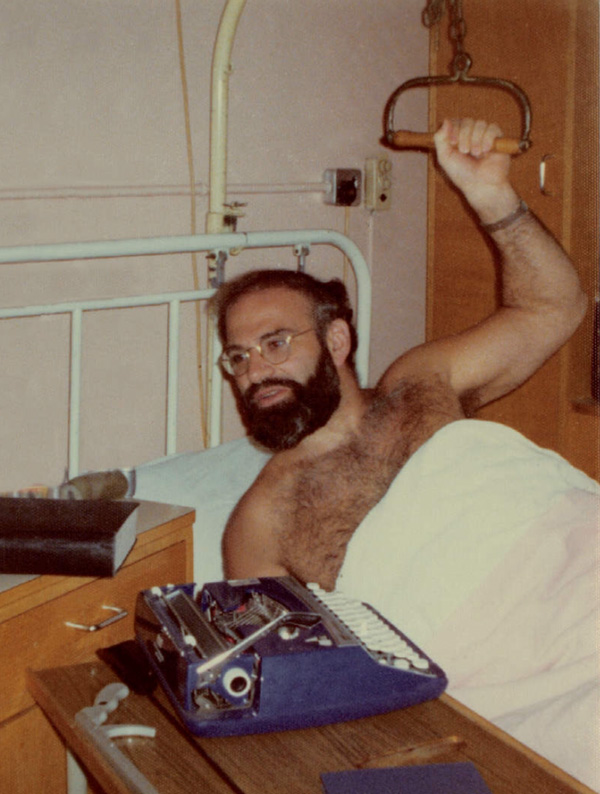
Dr. Sacks recovering in the hospital with nothing but a typewriter by his side. He had broken his leg in Norway, falling down a slippery canyon while being chased by a bull. (Courtesy of Oliver Sacks)
Sacks had befriended Thom Gunn in the early 1960s, but it wasn’t until after the publication of Migraine that he was able to engage with the poet in conversations about writing more confidently — a confidence further nurtured by Gunn’s encouraging feedback which, alongside the staunch support of Sacks’s beloved aunt Lennie, was instrumental in emboldening the budding writer to embark upon this far from easy path.
He talked with Gunn about “the process of writing, the rushes and stoppages, the illuminations and darknesses, which seemed to be part and parcel of the creative process.” Long before cognitive scientists came to study the psychology of writing, Gunn captured the mysterious psychological messiness of the process in one of his letters to Sacks:
I am a bit slothful at the moment. My pattern seems to be: a long cessation of any coherent writing after I have completed a MS, then a tentative start followed by, during the next few years, various separate bursts of activity, ending with a sense of the new book as a whole, in which I make discoveries about my subject(s) that I have never anticipated. It’s strange, the psychology of being a writer. But I suppose it’s better not to be merely facile — the blocks, the feelings of paralysis, the time when language itself seems dead, these all help me in the end, I think, because when the “quickenings” do come they are all the more energetic by contrast.
Sacks reflects on the sincerity of his friend’s values:
It was crucial for Thom that his time be his own; his poetry could not be hurried but had to emerge in its own way… “My income,” [he] wrote, “averages about half that of a local bus-driver or street sweeper, but it is of my own choosing, since I prefer leisure to working at a full-time job.” But I do not think Thom felt too constrained by his slender means; he had no extravagances (though he was generous with others) and seemed naturally frugal. (Things eased up in 1992, when he received a MacArthur Award, and after this he was able to travel more and enjoy some financial ease, to indulge himself a bit.)
I was particularly taken, and felt a deep kinship, with Sacks’s parenthetical note about Gunn’s ethos regarding writing about the writing of others:
Thom rarely reviewed what he did not like, and in general his reviews were written in the mode of appreciation.
Despite knowing his friend’s disposition toward criticism, Sacks recounts:
I sometimes felt terrified of his directness — terrified, in particular, that he would find my writings, such as they were, muzzy, dishonest, talentless, or worse.
But their relationship lived up to Emerson’s assertion that “a friend is a person with whom [one] may be sincere” — Gunn’s feedback, always in the spirit ofSamuel Beckett’s masterwork of constructive criticism, was monumentally beneficial to Sacks’s development as a writer, who was “eager for [Gunn’s] reactions, depended on them, and gave them more weight than those of anyone else.”
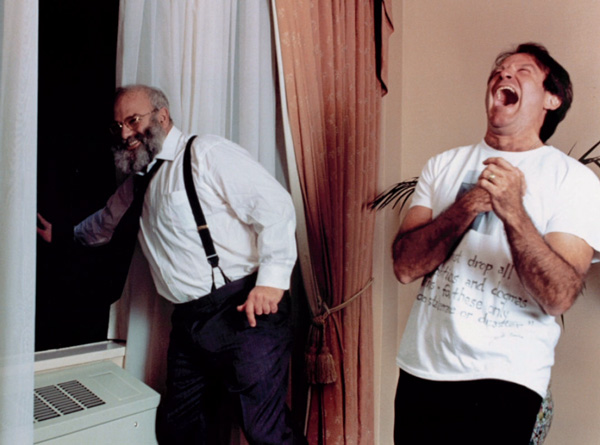
Dr. Sacks on the set of the cinematic adaptation of his book Awakenings, with Robin Williams, 1989 (Courtesy of Oliver Sacks)
But the feedback that most touched him was about his 1973 book Awakenings — a cultural classic that was eventually made into a film starring Robin Williams as Sacks. Gunn wrote:
Awakenings is, anyway, extraordinary. I remember when, some time in the late Sixties, you described the kind of book you wanted to write, simultaneously a good scientific book and worth reading as a well-written book, and you have certainly done it here… I have also been thinking of the Great Diary you used to show me. I found you so talented, but so deficient in one quality — just the most important quality — call it humanity, or sympathy, or something like that. And, frankly, I despaired of your ever becoming a good writer, because I didn’t see how one could be taught such a quality… Your deficiency of sympathy made for a limitation of your observation… What I didn’t know was that the growth of sympathies is something frequently delayed till one’s thirties. What was deficient in these writings is now the supreme organizer of Awakenings, and wonderfully so. It is literally the organizer of your style, too, and is what enables it to be so inclusive, so receptive, and so varied… I wonder if you know what happened. Simply working with the patients over so long, or the opening-up helped by acid, or really falling in love with someone (as opposed to being infatuated). Or all three…
Sacks adds:
I was thrilled by this letter, a bit obsessed, too. I did not know how to answer Thom’s question. I had fallen in love — and out of love — and, in a sense, was in love with my patients (the sort of love, or sympathy, which makes one clear-eyed).
But it was in Gunn’s poetry that Sacks found something else — something tremendously important to our understanding of how creativity works and the constant, necessary dialogue between influence and so-called originalitymediated by our imperfect memory, of which Sacks has written beautifully. Reflecting on Gunn’s intricate tapestry of influences — his creative lineage of what Margaret Mead termed our “spiritual and mental ancestors” — Sacks writes:
I loved the sense of history, of predecessors, in many of Thom’s poems. Sometimes this was explicit, as in his “Poem After Chaucer” (which he sent me as a New Year’s card in 1971); more often it was implicit. It made me feel at times that Thom was a Chaucer, a Donne, a Lord Herbert, who now found himself in the America, the San Francisco, of the late twentieth century. This sense of ancestors, of predecessors, was an essential part of his work, and he often alluded to, or borrowed from, other poets and other sources. There was no tiresome insistence on “originality,” and yet, of course, everything he used was transmuted in the process.
Gunn himself, echoing Montaigne’s sentiments about originality, addressed this in an autobiographical essay:
I must count my writing as an essential part of the way in which I deal with life. I am however a rather derivative poet. I learn what I can from whom I can. I borrow heavily from my reading, because I take my reading seriously. It is part of my total experience and I base most of my poetry on my experience. I do not apologize for being derivative… It has not been of primary interest to develop a unique poetic personality, and I rejoice in Eliot’s lovely remark that art is the escape from personality.
Dr. Sacks at home on City Island, the Bronx (Courtesy of Oliver Sacks)
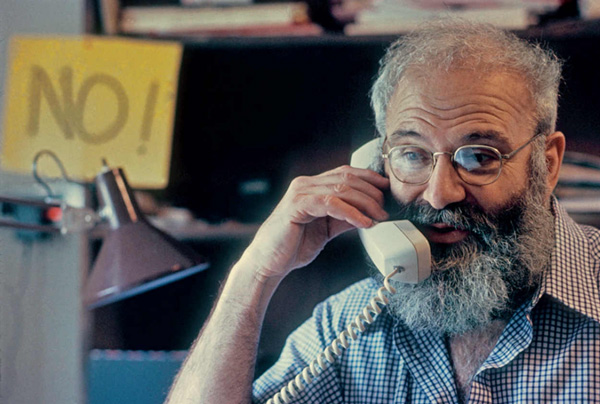
And yet art requires undisturbed personal space for the “quickenings” of the creative process to unfold slowly — something Sacks protected with great discipline as he blossomed into a prolific writer himself. In his house on City Island, he tacked a sign to the wall above his desk that simply read “NO!” — “reminding myself to say no to invitations so I could preserve writing time,” he explains. It is no accident that Sacks dedicates the final sentences in his autobiography to this great love of writing and, in a sentiment that calls to mindthe psychology of flow, fuses it with his great gift for science:
I am a storyteller, for better and for worse.
I suspect that a feeling for stories, for narrative, is a universal human disposition, going with our powers of language, consciousness of self, and autobiographical memory.
The act of writing, when it goes well, gives me a pleasure, a joy, unlike any other. It takes me to another place — irrespective of my subject — where I am totally absorbed and oblivious to distracting thoughts, worries, preoccupations, or indeed the passage of time. In those rare, heavenly states of mind, I may write nonstop until I can no longer see the paper. Only then do I realize that evening has come and that I have been writing all day.
Over a lifetime, I have written millions of words, but the act of writing seems as fresh, and as much fun, as when I started it nearly seventy years ago.
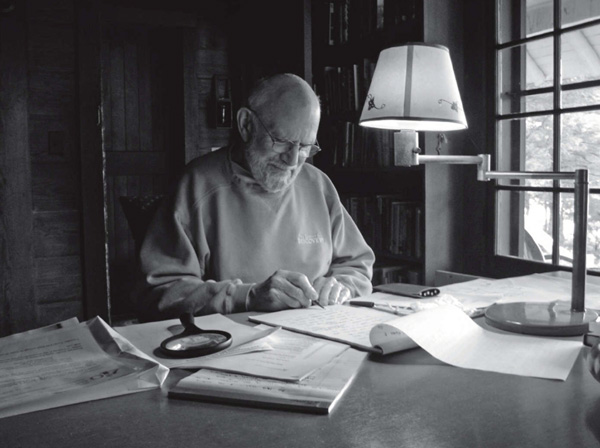
Oliver Sacks writing in his seventies (Photograph: Bill Hayes)
Every page of the altogether magnificent On the Move emanates this contagious delight in writing and furnishes an equivalent delight in reading — a sense of being invited, in the most generous way possible, into a lifetime of Sacks’s conversations with his own luminous, incessantly quickening mind. Take another step inside.
Donating = Loving
Bringing you (ad-free) Brain Pickings takes hundreds of hours each month. If you find any joy and stimulation here, please consider becoming a Supporting Member with a recurring monthly donation of your choosing, between a cup of tea and a good dinner.


You can also become a one-time patron with a single donation in any amount.


Brain Pickings has a free weekly newsletter. It comes out on Sundays and offers the week’s best articles. Here’s what to expect. Like? Sign up.