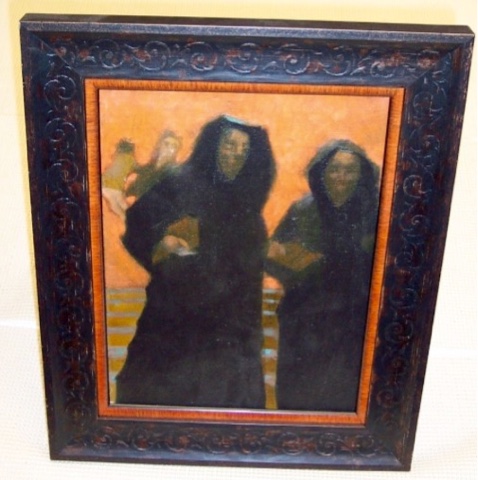
|
| Dan Wingren |
 |
| Dan Wingren |
Dan C. Wingren, Jr. was born in Dallas, Texas in 1923. His family moved to a small farm outside of Irving, Texas in the 1930s during his second year in grade school; Wingren graduated from Irving High School in 1940.
During World War II, he served in the army and was stationed in the South Pacific (New Guinea, New Britain, Philippines) and Japan (Tokyo, Yokohama). After military service, Wingren received a Bachelor of Arts degree in art in 1947 from Southern Methodist University (SMU) where he served as a lecturer from 1946 to 1947. While at SMU, he studied painting with Jerry Bywaters who was well-known as an artist and director of the Dallas Museum of Fine Arts (now the Dallas Museum of Art). He took additional classes at the Dallas Museum of Fine Arts School with Bywaters and Otis Dozier, both well-established Texas regionalists artists.
During the summer of 1947, Wingren traveled to Alpine, Texas to continue his studies with Dozier at Sul Ross State Teachers College, whose art department sponsored the successful “Alpine Art Colony” summer sessions taught by well-known regionalist artists. Also in 1947, he executed a serigraph of a color print for the portfolio XTOL by Octavio Medellin that was published by the Dallas Museum of Fine Arts.
Wingren received his Master of Fine Arts degree in 1949 from the University of Iowa where he studied with Mauricio Lasansky (printmaker), Hal Lotterman (painter), James Lechay (painter), and Byron Burford (painter). He stayed an extra year to work on a Ph.D under German-born art historian, William S. Heckscher (degree not completed).
In 1950, Wingren joined the faculty at the University of Texas in Austin as an instructor and later (1955) promoted to an assistant professor; he taught life drawing and creative design until 1958. In the mid-1950s, Wingren traveled to Europe and sketched images of towns and villages in France and Italy. In 1958, he was appointed director of the San Antonio Art Institute and taught painting at the McNay Art Museum (associated with the San Antonio Art Institute) until May 1961. He taught at Trinity University as a guest lecturer in the fall semester in 1961.
Wingren moved back to Dallas in May 1962 to paint full-time, although in the fall of that year he taught a design class at SMU. In 1963 and 1964, Wingren taught drawing and composition and oil painting at the Dallas Museum of Fine Arts School and, in 1965, he began teaching full time in the art department at SMU; he remained at the university until he retired in 1991. In 1971, Wingren was appointed Professor of Art; from 1969-1971 he served as Associate Chairman of the Division of Fine Arts. During his tenure at SMU, Wingren taught classes in art history (19th and 20th Century), design, drawing, and painting, and also conducted seminars on Contemporary Art topics.
Wingren exhibited his work extensively in Texas during the 1950s and 1960s by way of art museum exhibitions and independent organizations, including the Texas Watercolor Society and the Texas Fine Arts Association. His work was accepted into numerous Texas exhibitions in Dallas, Fort Worth, Houston, and San Antonio. In 1952, his oil painting "Explorer" received the $1000 "State Fair of Texas Purchase Prize" at the Dallas Museum of Fine Arts.
Nationally, his work was accepted into shows at the Carnegie Institute (Pittsburgh, Pennsylvania), Denver Art Museum (Denver, Colorado), Knoedler Galleries (New York, New York), Metropolitan Museum of Art (New York, New York), Oakland Museum of Fine Arts (Oakland, California), and the Walker Art Center (Minneapolis, Minnesota).
In 1955, Wingren was highlighted in the February issue of "Art in America" which featured articles on "New Talent in the USA." He was recognized in other art journals during the 1950s including "Carnegie Magazine," "Art News," and "Arts."
Wingren received the Catherwood Foundation Traveling Fellowship in 1957, which allowed him to travel through Europe and continue his art studies for a year. In 1959, Wingren, along with James Boynton and Paul Maxwell, both of Houston, Texas, exhibited their work at the Galerie du Colisée in Paris, France. The show was organized by Wingren’s long-time art dealer, Meredith Long, in Houston. In the late 1950s, Wingren’s painting "Magician’s Cabinet" was purchased by Bernard Dorival, director of the Museum of Modern Art in Paris, France (now the National Museum of Modern Art located in the Pompidou Centre), for the museum’s collection.
Wingren continued to show his work throughout Texas during the 1960s. In addition, he gave lectures on art and art history and taught drawing, composition, and painting at the Dallas Museum of Fine Arts. In 1966 he was honored with a one-man show, a retrospective of his work completed since 1958, at the Pollock Galleries, then located in SMU’s Owen Fine Arts Center. He continued to show his work in faculty shows throughout his career at SMU. In 1968, his work was included in the exhibition "The Sphere of Art in Texas," held at the HemisFair in San Antonio, and in 1979 he was one of nine artists represented in the book "The Texas Gulf Coast," published by Texas A&M University Press.
In the mid-1970s, Wingren, collaborated with art professor and colleague, Mary Vernon (Professor of Art, Altshuler Distinguished Teaching Professor at SMU), in teaching First Year Design for all art majors. They later concentrated on advanced design classes for students during a time when the art department was experiencing tremendous growth. During this period, he continued with his personal art work and made drawings that focused on photo-based imagery. Many of these drawings are part of the works on paper collection in the Pollock Gallery at SMU.
Wingren was also known to be intrigued with computer technology and in the 1970s built his own computer from kits and components at a time when personal computers were first being developed. He later commented “My head is somewhere near the intersection of the fields of art, history, psychology, engineering, and religion” ("Daily Campus," Southern Methodist University, June 21, 1988).
In 1979, his manuscript "Design and the Visual Image" failed to find a publisher because reviewers found the material "too advanced for the introductory college student" and "more appropriate for professional journals."
During the 1980s, Wingren continued to give lectures at the Dallas Museum of Art and to participate in gallery and museum exhibitions. In 1988, he was part of the exhibition, "SMU Salon," held at the Crescent Hotel in Dallas that included work by three generations of SMU art faculty, students, alumni, and distinguished guest professors. The work was auctioned and the proceeds benefited the Meadows School of the Arts scholarship fund. In the same year, Wingren was awarded the "Meadows Distinguished Teaching Professorship" (1988-1989) by Eugene Bonelli, Dean, Meadows School of the Arts. The award carried a $5,000 cash prize and an additional $5,000 in professional support. By this time his work had been featured in 16 one-person shows since 1952, mainly in Houston, Paris, and New York.
Seven years after he retired from SMU, Wingren died in Dallas on December 31, 1998, at 75 years of age. A year later, a large collection of his drawings was donated to the Pollock Gallery at SMU.
In 2006, his work was included in the exhibition "Shared Vision: Texas Artists Then & Now" at the Arlington Museum of Art, Arlington, Texas. The emphasis of the show was to look back and honor artists who had influenced contemporary Texas artists.
Wingren’s work is located in numerous Texas museums and private collections, including the Archer M. Huntington Museum (Austin), Dallas Museum of Art, Witte Museum (San Antonio), McNay Museum (San Antonio), Texas Instruments (Dallas), First National Bank (Fort Worth), and Bank of the Southwest (Houston).