Saturday, November 29, 2014

Harry Morgan: Inlaid Knifewing Bracelet


This "old-style" bracelet with a 1930s era-inspired design complete with Harry Morgan's "old pawn" finish features the colorful legendary Zuni inlaid figure of Knifewing. Harry Morgan inlays are extremely rare. "Old pawn" finishes mimic the patina and appearance of naturally-aged sterling silver.

The Knifewing, or the "Achiya La-da-ba" in the Zuni language, is a Zuni war god who also protects the Zuni pueblo from harm. Zunis believe that their war gods live in lakes in New Mexico and Arizona and appear as needed. To the Zunis, the Knifewing's role is similar to that of a patron saint.

In more modern times, Zuni legends tell of Knifewings swooping down from the heavens and kidnapping attractive Zuni women.

The Zunis, believed to be the direct descendants of the mysterious Anasazis of the Four Corners area (think the Mesa Verde ruins), have lived next to their revered Zuni Mountain (about 20 miles south of Gallup, New Mexico) for hundreds, if not thousands, of years. They successfully evaded the United States Army's 19th century internment and relocation campaigns (which were, more often than not, poorly disguised genocide programs) by hiding on Zuni Mountain for several years.

The bracelet shown here boasts 40 hand-cut black jet, white shell, red Mediterranean coral, and Sleeping Beauty turquoise inlays, in eight separate inlay channels. Harry Morgan added two short lengths of delicate triangle and twisted rope wire overlays and a hand stamped sacred shell on both shanks.

This revivalist bracelet has a maximum width of nearly two inches, and its sturdy three triangle wire open bracelet frame tapers to one-half inch in width at both reinforced terminals. 

Each inlaid bracelet is a unique work of art, and a comparable Harry Morgan bracelet, if available, would now carry at least a price tag of more than $2000 (if not more) in many New Mexico and Arizona galleries. This extraordinarily well-crafted, "old pawn" finish work of art is typical of the truly consummate attention to every detail that Harry Morgan was known and celebrated for. It's as "perfect" as any piece hand-made jewelry can be.

There are an extremely limited number of new, never previously-owned, Harry Morgan pieces of any kind offered in the marketplace. Before his premature death, he suffered a long illness that caused an substantial decline in his production. Even before his illness, Harry Morgan never made the choice that younger artists often make -- of compromising quality in order to achieve quantity.

If Harry Morgan's bracelets fit, and you can afford only one museum-quality piece, many collectors agree his work is the work to buy, both because of its inherent beauty and it's "investment potential."

Harry Morgan's hallmark and sterling stamp are found on the gap side surfaces of the terminal reinforcements.

Tribalism At Its Worst

Reminder: Please Do Not Feed the Fears

Tuesday, November 25, 2014

"Wrong" Perceptions Often Held About Highly Sensitive People


"You're just too sensitive. Don't take things so personally."

In a culture that favors the powerful, sensitivity can be seen as a deficiency. Sensitive people can be perceived as delicate, quiet and aloof, but that doesn't mean sensitivity is a negative trait. Being a highly sensitive individual may be more useful than the common wisdom would have us believe, according to researcher and psychologist Elaine N. Aron, Ph.D. In fact, as Aron explains, there are numerous misconceptions about people who, as she describes, "just feel more deeply."

Below are some "wrong" perceptions often held about highly sensitive people.

They're weak.

As a society, we tend to rank people based on certain characteristics -- and HSPs tend to evade those traits that are perceived as "strong." "There are different kinds of weakness," Aron told The Huffington Post. "They're more sensitive to pain, so they're going to avoid a fight; that might make them look weak because they're not aggressive. They have more emotional reactivity, so they cry more easily."

But their ability to pick up on others' emotions and intuitive nature offers a different type of advantage, Aron explains. "Highly sensitive people see things in a way that other people don't see," she said. "It's a different kind of strength."

They're introverts.

High sensitivity is often used synonymously with introversion, but while they share similar characteristics (like wanting downtime and having relatively quiet personalities), Aron says the two are not the same. In fact, approximately 30 percent of HSPs are extroverts, according to her research.

They're easily offended.

Sensitive people cringe over criticism, and when they receive it, it's something they reflect on internally rather than take as a personal offense. Because they try to avoid scrutiny at all costs, HSPs tend to criticize themselves first or avoid the source of criticism altogether, Aron previously told HuffPost.

They're shy.

One of the largest misconceptions about the personality trait is that people perceive HSPs as shy or neurotic individuals, Aron says. This could partially be due to their aversion to criticism or their reserved nature -- but Aron stresses it's important to distinguish the differences. "Shy is a fear of social evaluation, and we are not born with that fear," she said. "A lot of people study shyness today and they don't realize what's under the hood, they just look at the behavior."

All highly sensitive people are women.

Sensitivity doesn't discriminate based on height, weight, gender or job description. According to Aron, there are just as many men who possess the trait as there are women. "Being a sensitive man is difficult in our culture, but they are out there," she said. "There's no difference in how big and strong and masculine looking you are, if you're a man or a woman. It's not a matter of size."

They're prone to mental or physical illness.

Just like many other traits, it all comes down to variability in your genetics and environment. On average, a highly sensitive person is not at any more risk for mental or physical health issues, Aron says. In fact, if you're in a stabilized environment, the trait may even benefit you. "You're healthier than other people mentally and physically," she explained.

Aron also notes that the trait is not associated with the autism spectrum, like many people believe. Becoming easily overstimulated is a common thread -- especially in young children -- but she stresses that there are many other distinctions that parents should pay attention to and discuss with their doctor. "That's a difficult diagnosis to make in a very young child ... it's been misdiagnosed both ways, but they're different," she said.

Being highly sensitive negatively affects workplace success.

Because they're so intuitive, Aron says that sensitive individuals can actually use their trait to perform better. "It's not a handicap in relationships or at work," she said. "Sensitive people can use their observations to their advantage ... They're going to rise to the top. They know how to bring ideas up without being ridiculed or scorned."

They don't like big crowds.

While highly sensitive people do prefer to participate in activities (like exercise) solo, that doesn't mean they don't enjoy a large party or interacting in a big gathering. In fact, HSPs can thrive when there's social stimulation and some even find calm in large groups, Aron says.

They don't take risks.

It's a myth that highly sensitive individuals just want to stay at home or want everything calm and quiet all the time. Many HSPs seek high-sensation thrills like surfing and extensive traveling. Aron says they also choose careers where they can apply their traits while still finding stimulation and meaning, such as journalism or other service-based jobs.

You can easily identify a highly sensitive person.


In most cases, you probably won't be able to spot an HSP in a crowd, Aron explains. Save for a few eccentricities, like preferring alone time or a quiet restaurant over a noisy one, the personality trait doesn't often stand out. "They blend," she said. "They're creative, insightful and have a lot of empathy. People tend to like them."

The trait is abnormal.

Aron, who has been researching HSPs since the early '90s, says that nearly one in five people possess it. If you're interested in finding out if you're a highly sensitive person, you can take the self-assessment here.

Sunday, November 23, 2014

From the Michael Lebert Family Collection: Three Marvin Mangus Paintings


Marvin Mangus and Elder Lebert at the far left. Photo: Alaska, c. 1952

Art photos courtesy of Michael Lebert, who inherited these painting from his father, Elder.

Saturday, November 22, 2014

Marvin Mangus: Alaskan Landscape circa 1950s

Periodically, I do a Google Images search for fresh scans of my dad's paintings. Paydirt...here's a new one for the blog...

Marvin Mangus, an early oil painting, c. 1950s


Wednesday, November 12, 2014

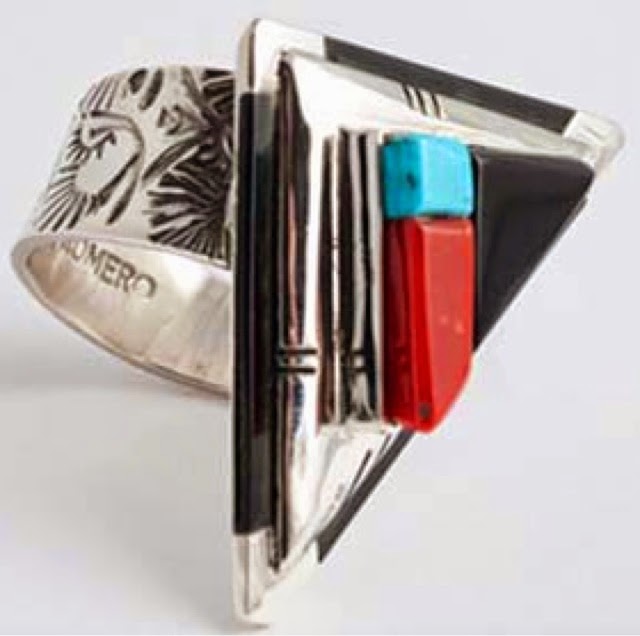
Ken Romero Jewelry: Pueblo Village Design Inlay


Ken Romero, an award-winning artist, was born in 1956, and is a member of the Taos and Laguna Pueblos in New Mexico. His rich heritage serves as an inspiration to his work and is reflected in the unique, one-of-a-kind pendants, rings, bracelets, and bolo ties he creates.

Ken is known for his elaborate lapidary work. He cuts directly from the finest stones, coral, and shells, and then shapes each piece to fit the most intricate design. "I design my pieces with inlay to look and feel like a village or pueblo building. I call this my pueblo village design inlay." All of the jewelry is completed with Ken's hallmark.

Ken is a full-time artist, working in the arts for over two decades. He has an Associate of Fine Arts Degree from the Institute of American Indian Arts and a BA from the California College of Art and Design. He has been awarded Best of Show, Best of Division and two Merit Awards just in 1998. He was also one of the selected Magnifico Artists in 1998.

"Throughout my life, I've always felt a deep need to fulfill a dream. My dream is to create beauty in art, and art as jewelry to be worn for all to see by expressing the colors of Native culture.
   
Contemporary Native American jewelry is my life's work. Intricate detailed semi-precious stone inlay, rich in colors and lasting weight, hallmark each piece fashioned into one-of-a-kind elegant work of fine jewelry. My work has been described as being 'Contemporary in Traditional Native Design.' My work has been shown in numerous prestigious Native American art shows with award-winning acceptance. 
   
With this acceptance, from present to future, I want to stay on the cutting edge of contemporary Native American jewelry design without sacrificing cultural identity, quality, or workmanship."