Showing posts with label SMU. Show all posts

Monday, December 24, 2018

The Owen Arts Center, Algur. H. Meadows School of the Arts, SMU

George L. Dahl


George L. Dahl


George L. Dahl


George L. Dahl


The Owen Arts Center in the Algur H. Meadows School of the Arts was designed by celebrated Dallas architect, George L. Dahl, and it opened in 1965. Dahl reportedly never submitted a bill for the project. 

Late in his life, around the time I arrived in Dallas (the late 1970s), Dahl was embroiled in a series of bitter legal battles with his daughter (and her family) over a trust that had been set up by his late first wife. 

In order to secure her money, Dahl's daughter tried to have him declared mentally incompetent, just as he was about to remarry -- and it led to many other legal cases. Dahl won his competency trial, but more lawsuits over the money ensued. D Magazine covered it in a wrenching in-depth article...


George L. Dahl


George L. Dahl


George L. Dahl


George L. Dahl


George L. Dahl


Al Mangus in the lobby of the Owen Arts Center, standing next to a Auguste Rodin sculpture.

Saturday, December 22, 2018

Memories of the Virginia Meadows Museum, 1965

Virginia Meadows Museum, SMU


Opening of the Virginia Meadows Museum, SMU


Dr. William B. Jordan and Algur H. Meadows


Virginia Meadows Museum, SMU


Formerly the Virginia Meadows Museum, now studio space, SMU


"The Meadows Museum is the leading US institution focused on the study and presentation of the art of Spain. In 1962, Dallas businessman and philanthropist Algur H. Meadows donated his private collection of Spanish paintings, as well as funds to start a museum, to Southern Methodist University. The museum opened to the public in 1965, marking the first step in fulfilling Meadows’ vision to create a 'Prado on the Prairie.'"

That was then. Now that the museum has been relocated to its own massive building, the original space that I "grew up with" has been converted to studio space and it's a heretical shock to my system to see how it's used now. Personally, as an exhibition space, I still prefer the original, more intimate space to the its newer super-sized one...


Wednesday, December 19, 2018

Jerry Bywaters: Landscape Paintings

Jerry Bywaters


Jerry Bywaters


Jerry Bywaters


Jerry Bywaters


Jerry Bywaters


Jerry Bywaters


Jerry Bywaters


Jerry Bywaters


Jerry Bywaters


Jerry Bywaters


Jerry Bywaters


Professor Jerry Bywaters (1906-1989) served for thirty-five years as a faculty member in Southern Methodist University’s Division of Fine Arts and as Director of the Dallas Museum of Fine Arts from 1943 to 1964.

Underlying all of Bywaters’ work was some perspective on the interaction of people and the land, whether the land served as a source of livelihood, a stage for historical events, a backdrop for architecture, or simply as a source of artistic inspiration. For Bywaters, familiarity with the natural world and incorporating it and its effects were basic to his art. 

In a 1928 letter explaining his decision to work as a studio -- instead of a commercial -- artist, Bywaters reminded his father that “I must be out of doors.” Landscape afforded Bywaters an avenue of experimentation with media and he worked with equal ability in oil, watercolor, and pastel. Although his artistic heyday was the ten-year period from 1933-1943, when he was able to travel frequently to Arizona, Colorado, New Mexico, and West Texas, Bywaters continued depicting landscapes long after he had turned away from other subjects.


Sunday, December 16, 2018

Suzanne Kelley Clark Painting

Suzanne Kelley Clark


Here's a recent 20" x 28" oil on canvas painting by friend and fellow SMU MFA graduate, Suzanne Kelley Clark.

Artist's Statement from her terrific website:

Since childhood, spending time in nature has been important to me. Painting landscape provides me with an even more profound connection to nature. It is an unending source of inspiration, challenge and discovery.

Tuesday, November 27, 2018

Susan Shiels Johnson: Recent Ceramics and Paintings

Susan Shiels Johnson


Susan Shiels Johnson


Susan Shiels Johnson


Susan Shiels Johnson


Susan Shiels Johnson


Susan Shiels Johnson


Susan Shiels Johnson


Susan Shiels Johnson


Susan Shiels Johnson


Susan Shiels Johnson


Susan Shiels Johnson


Susan Shiels Johnson


Susan Shiels Johnson


Susan Shiels Johnson


Susan Shiels Johnson


Susan Shiels Johnson


Here are some recent works by my long-time classmate (in the mid-1970s-to early-1980s) in SMU art school -- Susie Shiels (Johnson).

Artist's Statement:

I have always been interested in color and form studies, as well as pattern, previously working in the representational realm of still life and landscapes painted "on site." Recently, I have extended this inquiry to ceramics, at first focusing exclusively on functional work. While I continue to make cups and a few other objects for the table top, I am also making forms for purely visual exploration, with a departure point informed by natural objects, such as seashells and other organic forms. Firing some of the components in atmospheric kilns seems to be particularly conducive to realizing the surface and random patterns that I am chasing.


Saturday, November 24, 2018

Brian Carlson: "Aparecidos (the Appeared)", 2015

Brian Carlson


Brian Carlson


Brian Carlson


Brian Carlson


Brian Carlson


Brian Carlson


Brian Carlson


Brian Carlson


Brian Carlson


Brian Carlson


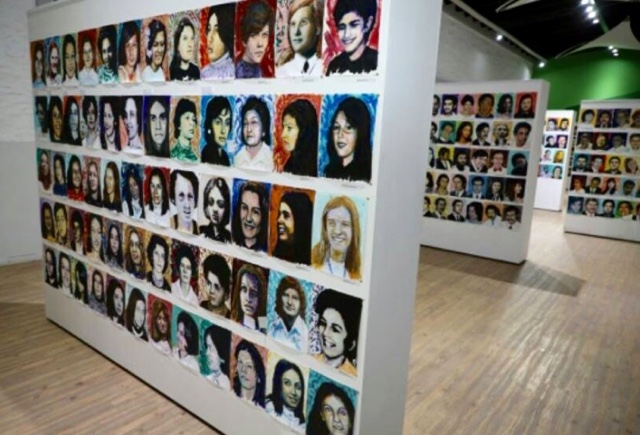
Between 1976 and 1983, somewhere between 9,000 and 30,000 Argentinians “disappeared” in the so-called “National Reorganization Process,” or  what is more commonly known as "the Dirty War." The reigning military junta took people they considered political dissidents, brought them to detention centers, and then tortured and killed them.

The journey to healing from this tragedy has been a long road that has yet to reach its end.  Military officials are still being prosecuted, while memorials to the lost are finally being made.  As it happens, one of the people working on the memorial lives in Ozaukee County, Wisconsin -- Brian Carlson.

"The tour of ESMA,” Carlson said, “was profoundly moving to me. In these spaces, nearly 5000 human beings, following abductions, had been tortured, held in the worst circumstances and then taken to be executed. I haven’t been to Auschwitz, but this is Argentina’s Auschwitz. I promised the disappeared that I would respond with a memorial and return to exhibit it, if possible, in that space.”

Carlson held true to his promise. He began to paint the portraits of the Disappeared and, as the portraits began to fill his studio walls, they created a “garden of memory. Carlson could see the possibility of what the portraits could do. He entitled his project "Aparecidos (the Appeared)." He wanted to, symbolically, bring back the people who had disappeared -- to ensure that they would not be forgotten, and that their lives may serve to warn people everywhere of what can happen when governments are allowed to oppress freedom.

“The opening of my exhibit at the Museo de Memoria in Rosario,Carlson says, “was the most incredible experience I have had in 35 years of professional art. To see members of the Madres de la Plaza looking at the faces of their lost ones, wearing their traditional white scarves; to have an overflow, standing-room-only crowd of guests -- most of them relatives of the disappeared, and many relatives of victims I had painted; to be thanked by so many for work that has been an honor for me to do -- is something I can’t describe.”

Aside from some professional development grants and the generosity of Argentinians who have welcomed him into their homes, Carlson does his work without any funding.  He paints every day of the week, but the schedule and finances are not as draining as the emotional aspect of painting the portraits.

I believe Aparecidos and its mission will spread and contribute to the decades of courageous human rights efforts in the involved countries,” says Carlson. “The message is memory, truth, justice and the sanctity of human life. It’s a critical message.”